The updated strategy builds on progress made over the last 20 years and reflects how the operating environment and mission scope have evolved, says NDA group chief executive David Peattie.
“Our mission is unique, dating back to the UK’s nuclear origins in the 1940s and expected to span into the next century. Much of what we do has never been done before and was never designed to be done,” he says.
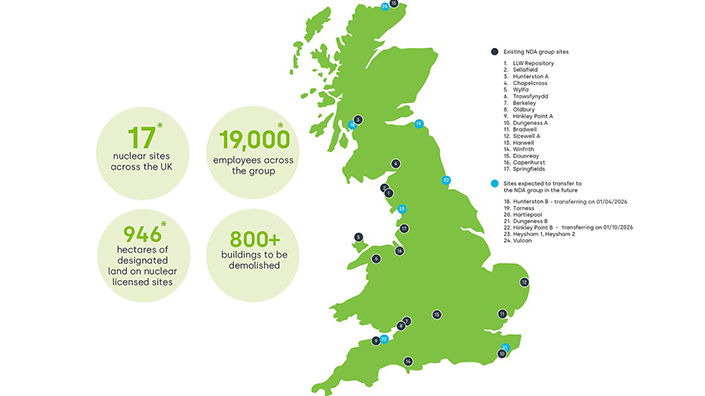
Legacy nuclear sites are spread across England, Scotland and Wales, and include the first generation of Magnox power stations, various research centres, fuel-related facilities and Sellafield, the UK’s largest and most complex nuclear site. The mission is set to expand from April with the transfer of Hunterston B from EDF – the first of seven advanced gas-cooled reactors to join the NDA estate over the next two decades, and the largest expansion of the authority’s remit since its creation in 2004.
The level of complexity involved is reflected in the total cost of the programme. Estimates shift constantly, but the current figure stands at about £260bn, with the NDA spending upwards of £1.9bn annually across its supply chain, indirectly supporting 40,000 jobs. Current plans indicate it will take 120 years to complete the main clean-up and waste management work, with the final end state (releasing the land for other uses) not expected until 2380. That makes it one of the longest-running, most expensive public commitments in British history.
Sustaining it depends on a continuous supply of people with the right skills. The challenge is that growing workforce demands come at a time when all areas of nuclear are booming – and competing for talent – simultaneously. Close to 100,000 people now work across the UK nuclear sector, a 55% increase over the past decade, driven by new build projects, defence programmes and decommissioning. An additional 40,000 workers are reportedly needed by 2030.
Yet the sector, like many engineering fields, faces an aging workforce. A third of civil and nuclear defence workers are over 50, with many nearing retirement. “This demographic reality, combined with the need to deliver major projects such as Hinkley Point C, Sizewell C, small modular reactors (SMRs), the Dreadnought and AUKUS submarine programmes, and decommissioning, underscores the urgency of ensuring a robust and future-proof talent pipeline,” writes Mark Rouse, skills director for the Nuclear Skills Plan, a joint endeavour between the UK government and nuclear industry.
What makes the pipeline challenge particularly acute for decommissioning is the nature of the expertise involved. Retiring engineers carry with them the accumulated, often tacit understanding of how aging facilities actually behave, as opposed to how they were designed to behave.
At sites such as Sellafield, which has systems and infrastructure that exist nowhere else, that knowledge is difficult – if not impossible – to recover once lost. Mid-career hires from adjacent sectors can address immediate, point-in-time skills shortages, but they cannot build the deep, decades-long knowledge the programme requires. What is needed long-term is people who enter early and stay.
(Credit: NDA)
The NDA is investing accordingly. More than 1,100 apprentices and graduates are currently on NDA schemes, with £55m committed to early careers schemes annually, often developing talent in some of the UK’s most remote communities.
Yesterday (March 10), the authority launched the One NDA Project Academy, an expansion of a programme initially piloted at Sellafield in 2016 that has since helped more than 7,000 people develop careers in nuclear.
The expanded academy covers all 17 legacy sites and offers qualifications ranging from short courses to degree-level. “I’ve seen firsthand the impact the Project Academy has had on people, who are now helping us to deliver infrastructure projects at one of the UK’s most complex sites,” says Andy Sharples, project director at Sellafield Ltd.
The academy will be operated by the University of Cumbria, continuing a relationship that began when the initiative launched a decade ago. Energus, a wholly owned NDA subsidiary, also based in Cumbria, manages the NDA’s early careers and recruitment services, including its sector-wide Nuclear Graduate programme, which has placed more than 1,000 graduates in industry since 2008.
“By strengthening early-career pathways and expanding opportunities for new entrants, we can build the capability and capacity needed to support one of the UK’s most complex engineering and environmental challenges for decades to come,” Nicola Bacon, head of people, skills and strategic partnerships at Energus, tells Professional Engineering.
Whether it is enough remains to be seen. For a 16-year-old weighing their options, cleaning up the consequences of the first atomic age may not have the public appeal of renewables or the profile of tech, but it is technically demanding, consequential and rewarding work. Some within the sector have begun making that case more deliberately. Given that the NDA’s next strategy update is not due until 2031, and the programme’s most intensive phases lie decades ahead, the urgency of that argument is only going to increase.
Want the best engineering stories delivered straight to your inbox? The Professional Engineering newsletter gives you vital updates on the most cutting-edge engineering and exciting new job opportunities. To sign up, click here.
Content published by Professional Engineering does not necessarily represent the views of the Institution of Mechanical Engineers.