Jerz, Holtec International’s director of engineering for the Palisades nuclear power plant in Michigan, US, believes that when – not if, as he points out during our interview – the facility wakes up from its slumber, it will lead other countries to consider restarting retired stations.
“We’re far enough into this that I have
no doubt it will happen,” he says. “We recognise that we don’t just have the eyes of the US Department of Energy, the US Nuclear Regulatory Commission, the state of Michigan or the US nuclear power industry on us. The eyes of the world in this industry are on Palisades.”
And those eyes are watching to see whether Palisades, which first came online in 1971 and was shut down for business reasons by the prior owner in 2022, can navigate the regulatory framework to restart a plant that was preparing for decommissioning, while overcoming the technical challenges involved.
“Can you bring a machine like this back when it’s been off for a period of time?” asks Jerz, his answer locked and loaded. “We’re going to prove it can be done.”
The start of a trend?
The Palisades plant is the world’s first to have its operating licence restored after shutting down for decommissioning. It’s now also received a fresh consignment of nuclear fuel, which it’s preparing to load into the reactor core. From here on out, the process to full power generation is routine – no different from any refuelling at any nuclear power plant around the globe. In other words, it is nearing the final stages of its landmark restoration.
It may be further down the track, but Palisades is not the only nuclear plant to be performing a u-turn. The reasons for a renewed interest in nuclear power range from nations looking to become more energy-independent to pressure to reach decarbonisation targets, and from electrification to the rapid growth of power-hungry AI data centres.
In Iowa, the Duane Arnold Energy Center plans to reopen by 2029. Shut in 2020, the plant has signed a 25-year agreement to provide 615 MW of “clean, reliable nuclear energy” to Google’s expanding cloud and AI infrastructure.
Leaving the past behind
In Pennsylvania, the site of America’s most serious nuclear accident on Three Mile Island has been reborn as the Crane Clean Energy Center, with one of the plant’s units due to restart in 2027. With a 20-year contract in place, the unit’s 835 MW output will feed Microsoft’s data centres.
The 1979 partial meltdown at Three Mile Island affected one of the plant’s two reactor units. That unit (Unit 2) is still being decommissioned, while the unit being restarted (Unit 1) was retired in 2019 for financial reasons. Its restoration is reportedly costing more than $1.5bn and involves replacing the main power transformer and filling a million-gallon water tank.
Other countries are not rushing to restart decommissioned plants, but some have changed their minds about shutting down existing stations or are exploring how to connect small modular reactors (SMRs) to existing infrastructure. Using existing sites for new technologies like SMRs saves years in applying for new operating licences and allows energy companies to take advantage of established grid connections.
Emotional roller coaster
Back at Palisades, Jerz says the past five years have seen a shift in public sentiment towards nuclear unlike anything he’s experienced in his career. And he’s worked at the plant for nearly two decades, coming from what he describes as a “nuclear power family”; his father spent 35 years at a nearby plant.
This half a decade has been a “roller coaster of emotions” for him. First came news of the shutdown in 2022. Jerz was tasked with leading the decommissioning as his engineering team shrunk from around 100 people to 10 (“You need fewer people to take things apart than you do to put things together”). Just as he accepted his new reality, and the possibility that he’d have to leave Michigan to find work, then came the “Wow! We’re going to start it back up” moment.
Active work to reboot Palisades began in late 2023. Fortunately, no major decommissioning work – such as barricading, removing pipes or pouring concrete into systems – had been carried out.
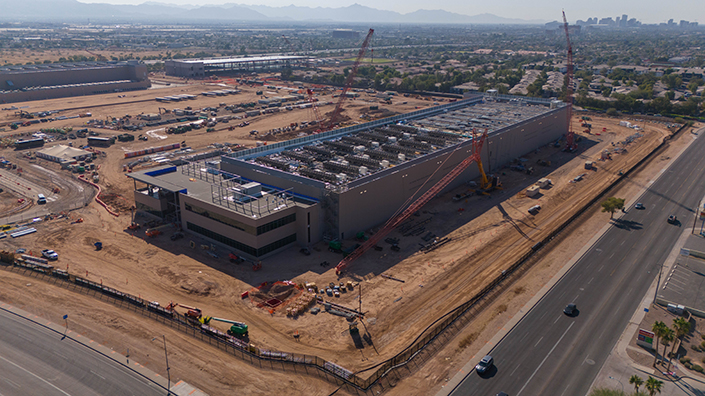
A data centre under construction (Credit: Wirestock Creators/Shutterstock.com)
Rare opportunity
As planning got under way, Jerz and his team realised they had a unique opportunity to carry out bigger repairs and generational upgrades. Typically, these would be done piecemeal during short refuelling pauses, but with the plant switched off they could all be done in one go.
“We are using the extended shutdown window to address a large quantity of things to help ensure long-term reliability and safety for the remaining life of our plant,” Jerz explains. Things like a digital turbine control system installed in the early 1990s (using late 1980s technology). “Think about the advancements in computer hardware from then to today, and the improvements you can make to control a large asset like this.”
Managing the restart project and these upgrades and repairs required a lot of coordination and scheduling. It also required a bigger team. Jerz set to work bringing back people who knew the plant and all its “unique complexities”, who could then share this knowledge with new recruits. It’s been an exercise in restoring expertise and growing the engineering unit back to a team nearly 100-strong.
Tackling engineering complexity
Inspecting and testing equipment that hadn’t run for years gave Jerz and his team a long to-do list. Pipes had been chemically cleaned to reduce residual contamination in the primary system. This cleaning process stripped a protective layer that shields stainless-steel pipes from corrosion – a protective layer that now had to be re-established. Major components also needed to be refurbished or replaced, including both turbine rotors.
To offer just one example, Jerz explains how his team found areas of degradation in portions of the steam generators during detailed inspections. This meant repairing the intricate network of tubes inside the heat exchanger to ensure continued integrity and performance. Removing tubes from service was not the most practical option if they wanted to work efficiently and remain compliant, so the solution lay in inserting sleeves into the tubes.
“This isn’t on some bench in a workshop,” he says. “We’re in a plant and guess what? In the location where I have to install these sleeves, I have to shoot them 20ft [about 6m] above my head, and I’m in a 4ft [just over 1m] hole. And then you have to do that a thousand times. And once that’s done, you get on with the maths behind it – you’ve reduced the diameter of the pipe, so what will the impact be on thermal performance? How does that compare with the sleeveless pipes? And so on…”
Many moving parts
And yet, ask Jerz how he explains all this to people outside his industry and he’ll tell you that, actually, it’s not as complex as you might think. To him, it still comes down to boiling water, creating steam and getting a turbine to spin.
“I have compliance rules and additional safety systems, but fundamentally, the machine is not complex – it just has a lot of moving parts,” he says.
And now that the plant is nearly ready to start generating 800+ MW of power, Jerz says that having played a role in its rebirth is hugely exciting. His hope is that people see nuclear energy not as competition to wind or solar, but as a partner in the wider energy mix, supplying a stable baseload to the grid.
Matthew Rooney, head of policy at IMechE, agrees, saying the world needs reliable dispatchable power and restarting retired nuclear stations bridges a gap that opened when the construction of new plants slowed down over the past few decades.
Restarts make sense
Nuclear plants are expensive and slow to build, Rooney explains, but once they’re operating, they are relatively cheap to run. He says he expects to see more mothballed nuclear plants being reopened.
“There is appetite for nuclear around the world. If you can get approval to extend the life of a nuclear plant, it makes economic sense,” he says.
“We would like to see progress in using not only the electricity that nuclear power plants produce, but also the heat. That heat is valuable and has multiple applications.”
As conversations around nuclear waste continue, Rooney says this is no longer a technical problem (methods to dispose of it safely are well known) but a political one, requiring social acceptance from communities.
That’s why building new-age SMRs adjacent to existing or awakening nuclear plants is a strategy energy companies are pursuing – companies including Holtec, which has plans for a two-unit, 680 MW SMR at Palisades.
Restarting nuclear plants generates something else: more expertise, which can be used in other settings, in other countries.
Earlier this year, Holtec and its partners cleared a major regulatory hurdle in the UK, preparing to bring its SMR-300 design to the Cottam site in Nottinghamshire.
No industry like it
Colin Tait, deputy director of regulation at the UK’s Office for Nuclear Regulation and a member of IMechE’s Nuclear Power Committee, believes the nuclear sector sits at the heart of some of society’s greatest challenges: clean, affordable energy; cost of living; national defence; and energy security.
“It’s a tremendously interesting field to work in,” he says. “The scale of the engineering challenge, the skill of the human endeavour, the number of people working at one time on some of the large nuclear power station developments is really inspiring.”
Tait says nuclear is an attractive field for talented engineers, ready to offer a “long-term, rewarding career”. The kind of career that Jerz relies on as he leads his team in restarting Palisades.
“There’s not an industry in the world that provides the growth and development opportunities that nuclear power provides,” says Jerz.
READ MORE: Nuclear plant restarts ‘likely to offer shorter deployment timescales’: IAEA
Want the best engineering stories delivered straight to your inbox? The Professional Engineering newsletter gives you vital updates on the most cutting-edge engineering and exciting new job opportunities. To sign up, click here.
Content published by Professional Engineering does not necessarily represent the views of the Institution of Mechanical Engineers.