This won’t be the first time a nuclear reactor has been sent into space (the US did it once in 1965, while the Soviet Union launched several into orbit). However, these were all used to power satellites, so today’s plans to land a reactor on the Moon are truly unique.
But why is a nuclear reactor even needed on the Moon? And what engineering challenges need to be overcome to get one up there?
The need for nuclear
If humans are to spend significant time on the Moon, nuclear power
is the only real option for meeting our energy needs. The simple reason is that the lunar night lasts for 14 days, followed by 14 days of sunlight. This means photovoltaic panels, currently used to power most deep space missions, just aren’t suitable. While you could, in theory, use solar energy to charge up batteries to get through the lunar night, this wouldn’t be very practical.
Dr Hannah Sargeant, a planetary scientist at the University of Leicester, explains why: “Batteries aren’t going to power a Moon base. You can’t do that on batteries for
14 days. It would be hugely mass-intensive to carry all of that battery storage” up to the Moon on rockets. On top of that, as any electric vehicle owner knows, batteries perform worse in the cold – and the lunar surface gets very chilly.
Therefore, a nuclear reactor is the only way to reliably supply energy to a permanent base that could keep working effectively through the lunar night. A NASA spokesperson says this will be “a fission surface-power system designed to keep the Moon base operating regardless
of the availability of solar power”.
On the grid
“NASA intends to route electricity on the Moon through a grid that will evolve over time from point-to-point user connections to a distributed system, similar to the power grids in the United States,” they continue. “The fission surface-power system will operate within the Artemis architecture to power NASA’s lunar exploration infrastructure, which will include habitats, logistics and other critical systems, and future Artemis partner and industrial users.”
But before looking at how this reactor would work, it’s important
to understand why we’d even want
a permanent base there. Having a crew of astronauts on the Moon’s surface for extended periods would enable lots of research into the origins of the solar system, but the real prize is water.
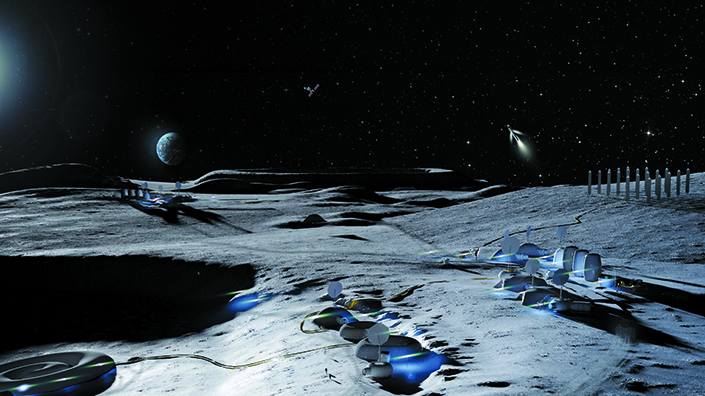
(Credit: Xtend Design. Supplied by the Moon Village Association)
Sargeant explains that the south pole of the Moon is known to have deposits of H2O. “Hydrogen and oxygen: that’s your rocket fuel,” she says. A nuclear reactor up there could be used to power drills to extract water. The reactor’s energy could then power electrolysis to produce hydrogen, which can be used as fuel. “The moon can become a pit stop fuel station,” Sargeant says, before astronauts continue onwards to Mars.
But why stop at the Moon on the way to the red planet? Because
the Earth has such strong gravity,
a huge amount of energy is needed to get out of its orbit. As a result, flying a crew directly from Earth
to Mars would be extraordinarily expensive. Only a very small number of astronauts could be aboard and the ship would be very small.
Lunar pit stop
By contrast, if these interplanetary adventurers could make a pit stop at the Moon (with its much lower gravity), they could pick up more fuel and supplies, and travel in a bigger craft. Besides serving as
an intermediary launch pad, a settlement on the Moon could also enable industry.
“Resources were identified on the surface of the Moon in the 1990s, particularly water, but then also rare earths, helium and a number of different resources,” says Giuseppe Reibaldi, a space policy expert and president of the Moon Village Association, an international organisation that aims to advance exploration of our rocky neighbour. With a steady source of power from a nuclear reactor, it might be possible to start mining for minerals that could support future industries.
To achieve these goals, NASA has been working with engineering firms
to develop reactor concepts and awarded contracts to Lockheed Martin, Westinghouse and IX (a joint venture of Intuitive Machines and X-energy) in 2022 to develop ideas. The ultimate goal would be for a 100kW reactor (roughly equivalent to the power needs of 80 or so homes). But the first reactor to land on the moon will be much smaller
– perhaps closer to 5 or 10Kw.
In March this year, NASA also announced plans for a nuclear-powered spacecraft called Space Reactor‑1 Freedom, which will be sent to Mars by the end of 2028 and demonstrate nuclear propulsion in space. That will be a stepping stone towards getting LR-1 on to the Moon’s surface two years later.
‘We have to do it differently’
Getting a nuclear reactor to the Moon and then making it work will be no mean feat.
“When we’re looking at the
space designs [of nuclear reactors], we have to balance the power
levels with the mass and volume constraints. And so we have to do things a little bit differently,” says Kerry Timmons, nuclear strategy lead at Lockheed Martin Space.
Start with simply getting the thing off the ground. The reactor and all its attachments, as well as a cable to attach it to a lunar grid, would need to be transported in a single launch. NASA’s spokesperson says “the reactor will be designed to fit within available rocket fairings”. At most, Reibaldi reckons such a reactor could not weigh more than a few tons. Anything heavier than that would be prohibitively expensive
to get out of the Earth’s orbit.
Enriched uranium
One way to shed some weight
might be to use more highly enriched uranium, which is less dense than the usual stuff.
“A lot of the terrestrial reactors use low enriched uranium at less than 10% enrichment,” Timmons says. “We’re looking at a newer technology, which is called high-assay low-enriched uranium (HALEU) fuel, which is 19% enrichment. So it gets us a little
bit more density of energy to optimise the mass for our systems.”
The reactor would also need
to survive launch, which is, as Sargeant mildly puts it, a “high-vibration environment”.
Indeed, NASA’s spokesperson points out: “The system will endure vibrations from launch and shock loads from landing, which are likely more extreme than the conditions
it will experience while operating
on the Moon.”
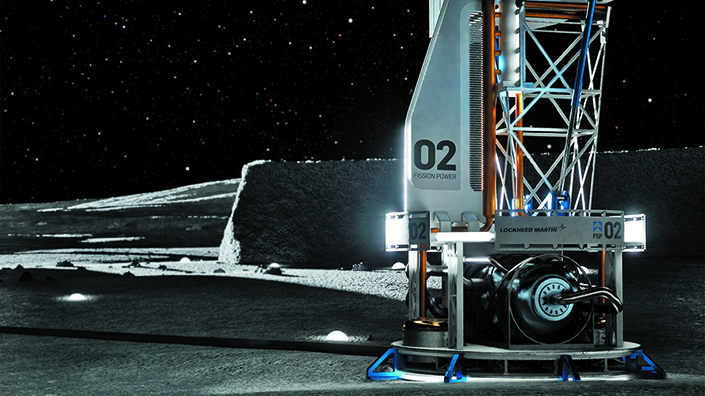
(Credit: Lockheed Martin)
To deal with the forces the reactor would undergo during take-off and landing, Timmons says Lockheed Martin’s designs will “use materials that are not only lightweight, but also have the right stiffness and support to maintain not only the launch loads, but the landing loads”.
The firm is also innovating with ways to ‘pack’ the reactor on to
a rocket efficiently. “We can do some interesting things that protect the vehicle during launch, like stow and fold radiators, and we have deployable booms that protect
it during launch.”
One concern the general public may have is around the risk of nuclear fallout should a reactor explode on launch or burn up in the atmosphere. However, Sargeant says: “Most of the design work is
on making these types of systems safe in various disaster scenarios.” She adds that levels of uranium enrichment would be comparatively low and reactors would not be switched on until they are well into outer space.
Moon life
Assuming we manage to get the reactor to the Moon, it has landed safely and been unstowed, how
will it work and survive the harsh environment it now finds itself in?
A key part of NASA’s requirements for any lunar reactor is that it uses a Brayton cycle. This is a way of using gases such as helium or nitrogen that circulate in a closed loop. The reactor would use conventional fission to heat the gas, which then expands to turn a turbine. That drives a generator and produces electricity. The gas is then
cooled, compressed and returns to the start before the cycle begins again.
A Brayton cycle is believed to be the best system for the lunar environment because it does not require fluids (which would behave differently in low gravity). It also has very few moving parts, which is important because performing any sort of maintenance on the reactor would be near-impossible.
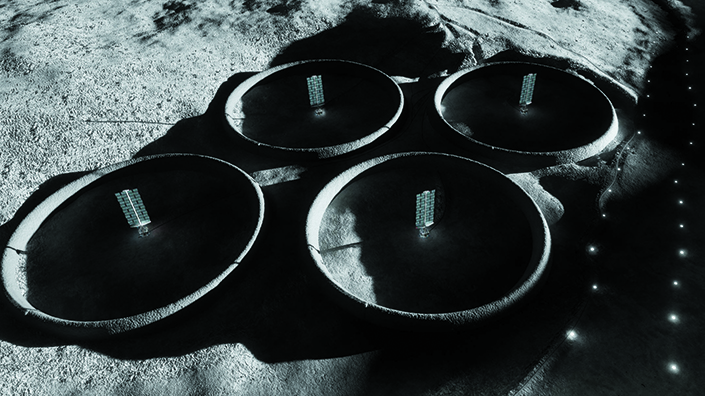
(Credit: Lockheed Martin)
But another big challenge is heat dissipation. Fission generates a lot of heat, so conventional terrestrial nuclear plants use either water or
air to draw it away from the reactor.
However, since the Moon is essentially a vacuum, water or air cooling aren’t possible. The most likely solution will be to use arrays
of radiators allowing heat to escape into space – something Lockheed Martin is focusing on.
A final challenge for any lunar nuclear reactor will be the extreme environment it needs to operate in.
Unlike Earth, with its comparatively steady temperatures and protective atmosphere, the Moon is a harsh place. Because it lacks its own atmosphere to burn them up, its surface is continually peppered
by (mainly) small asteroids. This would pose a real risk to any
nuclear reactor.
Hostile environment
Timmons says they’re taking this risk into account with their radiator designs. One option would be to “over-design the system to have extra margin so that if one panel is impacted [by a small asteroid], we would still meet the heat rejection needs” of the reactor.
Another option would
be to bury the reactor beneath the Moon’s
surface to reduce the risk
of such impacts.
A related challenge is regolith,
the layer of loose dust and stone
on the Moon’s surface. Because there’s no wind or water to smooth this material down, it is extremely abrasive. So, whenever future rockets land or take off from the Moon’s surface, they could accidentally throw this material
at the reactor and damage it.
One possible solution would be
to build walls of regolith around
the reactor to protect it from accidental dust showers.
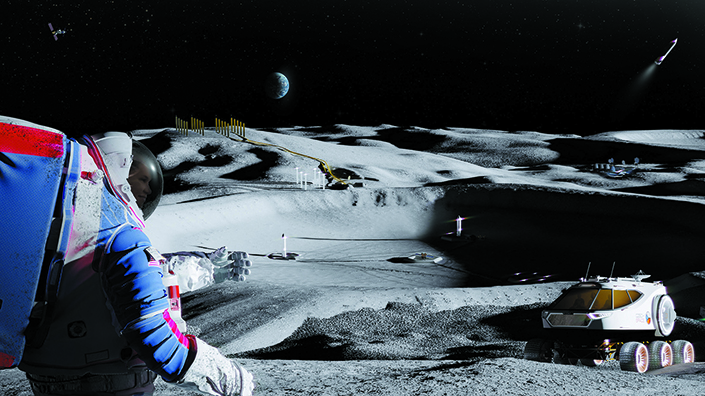
(Credit: Xtend Design. Supplied by the Moon Village Association)
Another challenge is the extreme temperature fluctuations the reactor would operate under. During the lunar day, the surface can reach more than 120℃, while at night temperatures can drop close to absolute zero. Choosing suitable materials for the reactor’s pipes
and casing – and ensuring they
can work for several years – is therefore essential.
At Lockheed Martin, Timmons says they’re using thermal
vacuum chambers that can be made to swing between these temperature extremes. This kind
of testing means the final reactor design will have withstood the extreme conditions it will face
on the Moon.
Mission 2030
“I think it’s good to have ambitions,” says Sargeant, with a wry smile. NASA’s goal to have a reactor
on the rock by 2030 is definitely bold, and there’s quite a bit of scepticism among experts about the realism of this plan.
However, as much as anything, this kind of target helps to focus minds and action. “There are challenges that we can’t foresee,” she continues. “So I would be surprised if they meet that target. But if it gets the ball rolling, then it’s a really good thing because we just haven’t been able to have nuclear reactors make it back into space. By having this kind of commitment, it means that the resources will be directed towards it.”
Whether or not the 2030 deadline is met then, it seems likely that, sooner or later, our planet’s moon will play host to its own nuclear power station.
Want the best engineering stories delivered straight to your inbox? The Professional Engineering newsletter gives you vital updates on the most cutting-edge engineering and exciting new job opportunities. To sign up, click here.
Content published by Professional Engineering does not necessarily represent the views of the Institution of Mechanical Engineers.