READ THE LATEST: British engineers power hydrogen car to world record 406mph
Chairman Lord Bamford – then Sir Anthony Bamford – had a “bold vision”, says powertrain engineering director Ryan Ballard. “He’s always had a passion for speed and motor racing,” Ballard says. “And, as it turns out, he’s always been really interested in land speed records.”
The result, just two years later, was Dieselmax. Driven across the Bonneville Salt Flats in Utah by RAF wing commander Andy Green OBE, the slickly streamlined car in signature yellow set the world diesel land speed record of 350.092mph (563.418km/h), which still stands today.
The record run on 23 August 2006 cemented JCB diesel engines as some of the highest-performing options on the market. Two decades on, the Staffordshire firm has made and sold a million. “We’ve well and truly proven what they’re capable of,” Ballard tells Professional Engineering. “Our customers absolutely love them.”
Now the company has another new engine to promote – and another plan to clinch a world land speed record. “It’s almost history repeats itself,” Ballard says, as preparations intensify for Green to once again take the wheel at Bonneville, this time in the hydrogen-powered JCB Hydromax.
Tweaking the formula
Unveiled last month at JCB’s Rocester world headquarters, Hydromax is powered by the firm’s hydrogen internal combustion engines, developed over the last five years. Picked because of concerns that fuel cells are not robust enough for industry, the technology is now powering diggers rolling off the production line.
The project has several aims: to beat the world hydrogen land speed record of 303.004mph (487.621km/h); to go even further by beating the Dieselmax speed; and to demonstrate the best of UK engineering on the world stage.
Doing so will be far from easy, however, and the team has been working hard to solve several major challenges ahead of the return to Utah this August. Principal among these is placement of the two production-based engines in the 32ft (9.75m) car.
“Last time we sat the driver in between the two engines – two engines driving the front and rear wheels,” says project director Ballard, speaking shortly after the unveiling. “That all worked really well so we’ve repeated that formula.
“But very quickly we realised, well, we’ve got to store some hydrogen on the car. We’ve got to make space for that with the tanks.
“Unfortunately, one of the realities of life is the Bonneville Salt Flats – the race track there is getting shorter year on year; there’s erosion of the salt flats. So we realised that we need spare capacity, in terms of performance, to better the Dieselmax record… We’ve got to move them further apart to make space for the hydrogen tanks, and we want to make the car more efficient – so lower weight, lower drag.”
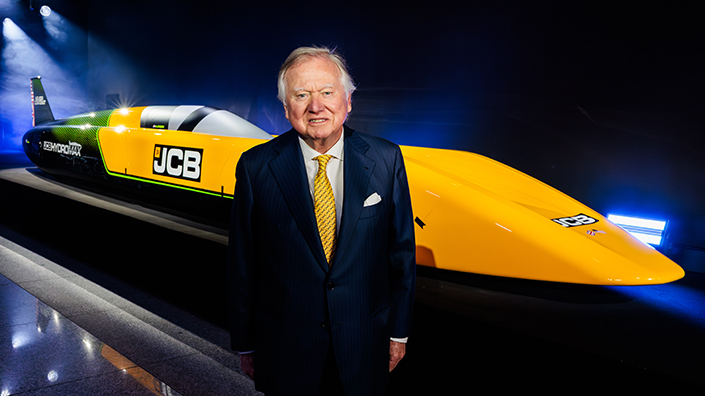
Lord Bamford with the Hydromax
Much was carried over from the production engines, with elements including the block, head, crank, pistons and valve train. Breaking the record requires a lot more power, however, so some modifications were inevitable. The fuel system was upgraded to bring in more fuel, as was the boosting system to increase the amount of available air.
The huge increase from 80 brake horsepower (bhp) to 800bhp per engine brought further challenges. “We had a lot of problems with sealing the cylinder head to the block; the head gasket joined that interface there. It took a lot of work to get that right, the boosting, how to get the air in, the fuel,” Ballard says.
Upgrades on the Dieselmax car design include using Naca ducts rather than a scoop, for better aerodynamic efficiency. A lot of work was also needed to make the car stable, involving a blend of classic chassis dynamics and aerodynamic influences. “We’re all maximum longitudinal stability, minimum drag,” Ballard says.
In the balance
With Green came a wealth of experience from Thrust, the overall world land speed record-holder, and the attempted follow-up in Bloodhound. That project’s lead aerodynamicist, Professor Ben Evans from Swansea University, also came over.
Both experts were involved in solving the long-running problem of hydrogen tank placement. “In the end we settled for two fairly short, stubby tanks running longitudinally, just behind the driver,” Ballard says. “But in order to fit those in, we had to move Andy forward slightly, move the engines further towards the wheels, so compress the gearbox to do that…
“All of that was done in conjunction with Ben and Andy. There have been many, many conversations about things that they found on Thrust – good bits and bad bits and lots of really great anecdotes.”
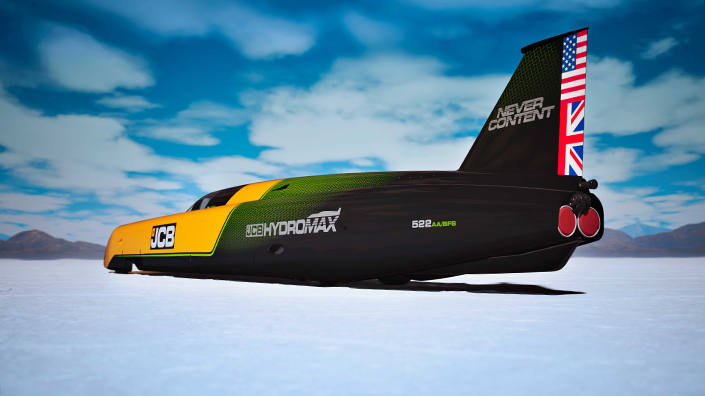
Some key aspects are very different, however – including the fact that Hydromax is wheel-driven, rather than jet engine- and rocket-propelled. “The coefficient of friction between the salt and the tyres plays a really strong part in it,” Ballard says.
“It’s like trying to go as fast as you possibly can on a very wet motorway. So it’s actually quite a difficult thing to do to get the traction, to lay the power down, so you do actually need quite a long time to get up to speed.
“And then, of course, you’ve got the opposite problem. You've got to slow down before you reach the end of the salt, otherwise the salt goes to nothing. You can end up in mud, effectively, and it can actually be quite dangerous, because then the car can dig in and tip over.”
That challenge is compounded by a weather-dependent track length. The Flats’ salt conditions will only be known this month as they start to dry out following spring, so the JCB team has based its calculations on “pessimistic” possibilities.
“What became important to us is to make sure that we can accelerate as quickly as we can, to get up to a speed so we can place the measured mile where we need it, and then give sufficient time for us to slow down,” Ballard says. “It’s quite a balance.”
‘A lot of people were eager to tell us what a bad idea it was’
If Dieselmax showed what diesel could do, the hope is for Hydromax to do the same for hydrogen combustion. “When we started our production programme for the hydrogen engines, there were an awful lot of people very eager to tell us what a bad idea it was, and that the efficiency would be bad. We proved them wrong there,” Ballard says.
“People would talk about the NOx emissions, and we dealt with that; we’ve dealt with that very effectively. And, of course, then they talk about the performance. And so we see that, well, we’re definitely going to prove them wrong there with the performance as well.”
Described by Green as “the world's fastest (and most exciting) zero-emissions vehicle”, Hydromax also has the twin aims of demonstrating the engineering prowess of JCB and the UK.
Supported by partners Prodrive and Ricardo, the project will show apprentices “this is what engineering is”, Ballard says. “This is what you can do, and we’re doing it here in the UK, and this is something to be incredibly proud of.”
He adds: “Anything’s possible as an engineer… your imagination is the limit.”
Of course, hydrogen combustion will likely struggle to match the success of diesel. Even if the project clinches a new world record, it is hard to know the future of the technology.
“For the off-highway industry, it makes a heck of a lot of sense,” Ballard says. Big machines need a lot of energy, but work is often done “nowhere near a grid connection”. Hydrogen can be brought to the machine, JCB says, and it is suitable for the frequently demanding work schedules.
On the road could be a harder sell – but Ballard points out that long journeys in the US or mainland Europe often require more range than what EV batteries can provide. If Hydromax shows what hydrogen can do, who knows where the market will be in 20 years?
Want to hear more about the Hydromax project from the engineers who made it happen? Ryan Ballard will deliver a plenary titled ‘Land Speed Record – How We Got There with the Hydromax Project’ at IMechE’s Advancing Automotive Engineering event on 4 November. The following day, an extended engineering case study will be presented for the H2ICE event stream by Chris Ward, chief engineer of engines. Find out more and register for the event at the British Motor Museum in Warwick on the conference page.
Want the best engineering stories delivered straight to your inbox? The Professional Engineering newsletter gives you vital updates on the most cutting-edge engineering and exciting new job opportunities. To sign up, click here.
Content published by Professional Engineering does not necessarily represent the views of the Institution of Mechanical Engineers.