Sponsored features
We’re hopefully moving through the COVID-19 pandemic now and, as life begins to return to a more ‘normal’ footing, many manufacturers are instigating plans to ensure a strong recovery. But pandemic learnings must be taken on board, including the importance of resilience in key plant operations.
From RS Components’ perspective, we partner with senior engineers to help build the required plant resilience by playing a strategic role in the supply chain. We offer bespoke services and solutions specifically aimed at supporting plant resilience from inventory and procurement to maintenance and design solutions.
Plant resilience matters
If we can collectively transform UK manufacturing resilience, we could, according to independent research, add £26bn of productivity value to the UK economy.
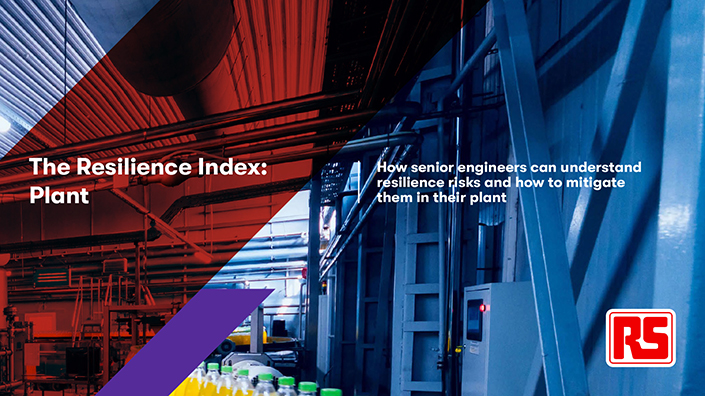
The finding was from The Resilience Index, commissioned by RS Components. The report looks at three building blocks of industrial resilience, plant, process, and people. The first exploration is plant resilience. It highlighted that, by focussing on five investment areas, senior engineers can improve plant resilience to support business security, enhance productivity, and create commercial opportunities.
The five golden investment rules are:
1. Anticipate Shocks – whether it is the ever-present threat of a cyber-attack or using research and analysis to identify signs of changing or emerging trends in customer behaviour, investment that puts companies on the front foot will pay off in the long run.
2. Resist Disruptions – building resistance to possible future production disruption is an area where strategic investment can have a positive impact. Whether this is taking steps to ensure flood defences are in place (if appropriate) or moves to mitigate the potentially disastrous consequences of a cyber-attack. Think also about ensuring a healthy working relationship with trade unions.
3. Absorb Shocks – if shocks happen the establishment of, and investment in, building multiple production lines or facilities, or adapting product lines or finding substitutes, will enable business to keep functioning. On an ongoing basis, the strategic management of ageing assets and condition monitoring is vital to ensure business continuity with maintenance and replacement programmes a clear priority.
4. Invest in Recovery – in the broadest sense, not just IT – look at insurance policies, the viability of systems and the development of a culture that enables remote working and other measures to get back to capacity.
5. Innovate for the Future – innovation requires an outward looking, agile company culture – the kind of attitude that helps to progress the previous four resilience-building investment areas. Investing in transformation, including innovation and R&D around original designs and machine specification is not just about making reactive incremental adaptions, but the proactive creation of new systems, products, and models to ensure a business continues to be relevant.
Developing a resilience roadmap for plant operations is a necessity if senior engineers are to help UK industry optimise its true potential.
To get a copy of The Resilience Index: Plant, visit: https://www.rs-connectedthinking.com/en/operational-efficiency/insight/the-resilience-index-plant
Get to grips with the future factory: sign up now for our Advanced Manufacturing briefings (19-23 July), part of the Engineering Futures series.
Content published by Professional Engineering does not necessarily represent the views of the Institution of Mechanical Engineers.