Opening the conference at IMechE’s Westminster headquarters last week (14-15 October), Toby Perkins MP, chair of the House of Commons Environmental Audit Committee, warned that the UK’s infrastructure and governance structures remain dangerously exposed to climate risks. He urged government and industry to treat adaptation as a national priority equal to emissions reduction, arguing that resilience “should be built into every investment decision”.
Perkins emphasised that cross-departmental coordination, independent scrutiny and private sector engagement are essential if the UK is to move beyond piecemeal responses to extreme weather and environmental stress.
From a global perspective, Roberta Boscolo, head of climate and energy at the World Meteorological Organization, underscored the pace of planetary change. She confirmed that 2024 was the hottest year on record, with temperatures exceeding 1.5°C above pre-industrial levels for the first time. Ocean heat and sea level rise are accelerating sharply, she said, undermining food security and progress on the UN Sustainable Development Goals.
Boscolo called for all adaptation planning to be guided by forward-looking climate data rather than historical trends: “The risks of the future are not the risks of the past.”
Baroness Brown of Cambridge, chair of the UK Climate Change Committee’s Adaptation Committee, reinforced the urgency of delivery. Despite a robust legal framework, she said the UK is “still not a well-adapted country”, warning that, without stronger action, heat-related deaths could exceed 10,000 per year by mid-century.
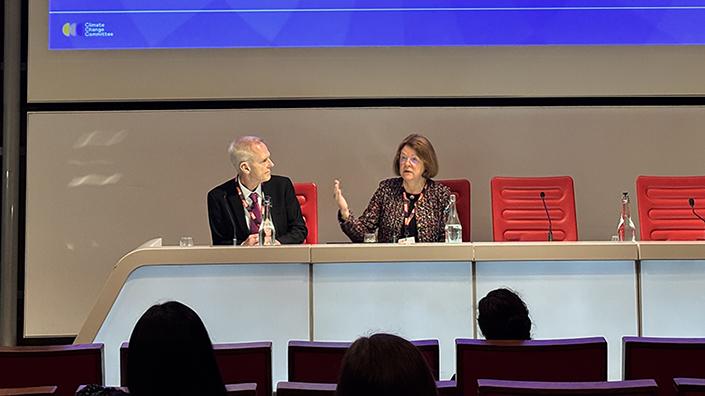
Dr Tim Fox and Baroness Brown of Cambridge speak on stage at the event
Adaptation, she argued, must become mainstream across all sectors, from planning and health to infrastructure regulation, with clear targets, measurable outcomes and improved monitoring.
Carlos Ruiz-Garvia of the UN Framework Convention on Climate Change Adaptation Committee added that the world is heading for 2.8 to 3.3°C of warming by the end of the century on current trajectories. He called for engineers to play a stronger role in implementing national adaptation plans, particularly in infrastructure, energy and water systems. “We are now moving from the what to the how,” he said, highlighting the need for innovation and scaled-up private finance.
From Japan’s Ministry of Economy, Trade and Industry, Norihiro Kimura shared lessons on bridging the adaptation finance gap. Only around 5% of the $387bn needed annually by 2030 has been successfully financed, he noted, urging greater private sector involvement.
Kimura said that Japan’s Subaru Initiative, in cooperation with UN-Habitat, shows how technology transfer, from compact weather radar to micro-wind power, can link mitigation and adaptation while supporting developing nations.
Finally, Professor Lyla Mehta of the Institute of Development Studies challenged the engineering community to confront the “politics of uncertainty”. Drawing on research in India and Bangladesh, she argued that top-down adaptation often marginalises the communities it aims to protect.
“Uncertainty cannot be managed like risk,” she said. “It must be lived with. And it can open opportunities for transformation.”
Mehta called for alliances between technical experts, social scientists and local people to work together for socially just adaptation.
Across the day’s discussion, six themes emerged: the need for joined-up governance; investment in climate-resilient infrastructure; forward-looking data and science; fairer financing; locally led adaptation; and deeper integration between technical and social disciplines.
The second day shifted focus from policy to practice, from designing frameworks to delivering resilience. Speakers from government, academia, industry and the energy sector examined how technical assessments, regulation and finance can turn ambition into measurable outcomes.
Dr Regina Asariotis, chief of policy and legislation at the UN Conference on Trade and Development, warned that climate adaptation remains “chronically underfunded and structurally underprioritised”. She urged engineers to play a greater role in shaping global standards, arguing that “we cannot afford to treat resilience as an optional add-on to development; it must be built in from the start”.
She called for international policy alignment between infrastructure planning, trade and climate resilience, noting that “inconsistent regulatory approaches are leaving many developing economies exposed to systemic risk”.
Infrastructure resilience specialist Dr Guy Félio highlighted the role of local governments. “Cities are on the front line of climate impacts,” he said.
Félio outlined how Canadian municipalities are adopting a risk-based asset management framework to integrate adaptation into infrastructure investment cycles. This approach, he argued, allows decision-makers to “plan for uncertainty without paralysis”, a mindset he said UK policymakers should emulate.
Céline Phillips, coordinator at the Multilateral Initiatives Unit, Europe and International at the French Agency for Ecological Transition (Ademe), reinforced the importance of system-wide thinking. She argued that resilience policy must move beyond asset-by-asset approaches towards integrated network planning, supported by accessible data.
“We need consistency in the way we define, measure and report adaptation,” she said, warning that fragmented metrics risk undermining investor confidence.
Phillips called for a national standard for resilience performance, mirroring the success of net-zero benchmarking.
EDF Energy demonstrated how a major operator is embedding adaptation within one of the UK’s most regulated industries. Katie Fish, climate change adaptation engineer, outlined the company’s framework for ensuring its nuclear assets remain resilient into the 22nd century. “We’re designing for one-in-10,000-year events,” she said, describing a process built around five-year climate reviews and site-specific adaptation plans.
Her colleague Jack Bauchop, natural hazards research engineer, detailed EDF’s use of ‘extreme value analysis’ to model meteorological and hydrological hazards. “We want to add value beyond numbers,” he said. “That means contextualising the data so end users actually understand what it means for their sites.”
Martin Donohue, also an EDF climate change adaptation engineer, discussed how these assessments feed into site-level risk frameworks. Using Sizewell B as a pilot, EDF has integrated climate risk assessment into its long-term operation strategy. “No infrastructure is new to climate change,” he said, stressing that adaptation must be embedded early in asset life-extension programmes.
Closing the conference, Jonny Krzyzosiak, climate resilience lead at Mott MacDonald, presented PCRAM 2.0, a methodology for quantifying the financial value of resilience. “Resilience delivers value,” he said, “but unless we can measure it, those benefits are invisible to decision-makers.”
He argued that policy should encourage investors to recognise resilience as a source of long-term return, not just a cost.
Across the second day, a clear consensus emerged: adaptation must become more data-driven, standardised and financially integrated, moving beyond rhetoric towards measurable, funded action. Engineers will be central to that transition, speakers agreed, translating climate science and policy intent into infrastructure that can endure the uncertainties of a changing planet.
Alongside the plenary sessions, technical discussions explored the impacts of heat, flooding and drought in both rural and urban settings. Sessions covered advanced modelling systems for extreme events and the role of nature-based and nature-positive solutions in mitigating risk and strengthening community resilience.
Looking ahead, an industry-focused workshop following up on themes from the conference will take place at Brunel University on 26 March 2026, followed by an adaptation seminar in Japan from 6-8 September 2026 focusing on the resilience of the nuclear industry.
Want the best engineering stories delivered straight to your inbox? The Professional Engineering newsletter gives you vital updates on the most cutting-edge engineering and exciting new job opportunities. To sign up, click here.
Content published by Professional Engineering does not necessarily represent the views of the Institution of Mechanical Engineers.