Formed due to soot released during fuel combustion, contrails and the cirrus clouds they create could account for more than half (57%) of aviation’s climate impact, according to a 2021 study published in Atmospheric Environment. While some estimates are lower, it is a vital area of study if aviation is to remain a viable mode of transport in a warming world.
“There are two parts to the emissions that come from aviation,” says Andrew Symes, CEO of sustainable aviation fuel (SAF) producer OXCCU. “The first is the actual CO2 that’s emitted by the plane, and that can be eliminated – for the most part, at least – by going for circular biofuels, so that the CO2 has come from the atmosphere and then it goes back to the atmosphere.”
The Oxford University spin-out now hopes to find out if its synthetic crude Oxfuel, created using a novel catalyst and reactor design, could also reduce the second part. Awarded a £1.8m grant in November from the Aerospace Technology Institute (ATI), it is investigating whether SAF specification can reduce contrail formation.
Catalysts for change
Situated at Oxford Airport, OXCCU’s OX1 plant has been producing SAF since 2024. Production is only at demonstration scale – one litre per day – but the company plans to expand in the coming years.
Unlike bio-based SAF produced from waste and animal fats, Oxfuel is a power-to-liquid fuel, formed from simple chemical building blocks. The process used an iron-based multifunctional catalyst that first converts CO2 to carbon monoxide, before reacting that with hydrogen to form hydrocarbons.
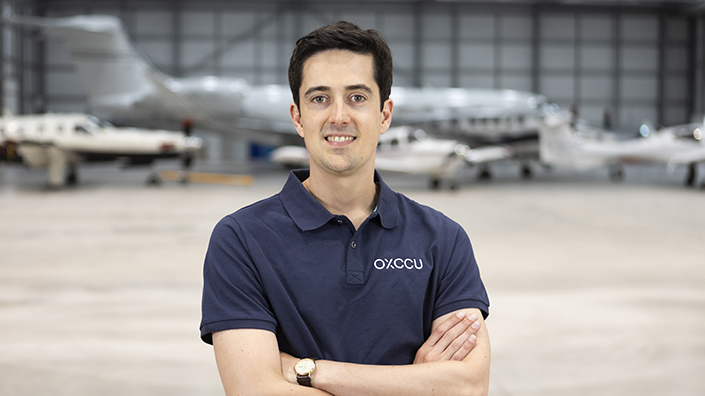
OXCCU CEO Andrew Symes
In the ATI-funded project, OXCCU aims to show that jet fuel production can be tuned to have a range of different components, then to prove a potentially significant impact on global warming. While all hydrocarbon fuels consist of carbon and hydrogen molecules, the ways they are arranged can provide different properties – the ratio of carbon to hydrogen can vary, for example, while some molecules are branched, some are straight, some are in rings and some are in aromatic rings. Those aromatics are closely tied with a fuel’s propensity to form soot, Symes says, as they contain more carbon.
“Therefore the interesting question becomes: ‘If you reduce the aromatics content of the jet fuel, do you then reduce contrail formation?’” he says. “With our process, we can tune the amount of aromatics that we’ve got in that end fuel – and a lot of the new SAF coming up could actually have no aromatics.”
The first step will be to show that the production method – based around the Fischer-Tropsch process – can make different fuels depending on reaction conditions and upgraded catalysts. Those catalysts could remove residual oxygen from the synthetic crude, increase the number of branched molecules and remove aromatics.
Clearing the air
Part of a programme delivered by the ATI, the Department for Business and Trade, and Innovate UK, the OXCCU project runs from July 2025 to June 2027. If it succeeds in its aims, “the next step will be to then persuade the engine companies… to widen the certifications, to enable us to be able to get that to market,” Symes says.
The company is building the OX2 facility, which it hopes will produce 30 litres of fuel per day from 2027, followed by a commercial plant by the end of the decade. The UK’s SAF mandate will require 10% of jet fuel demand to be met by SAF by 2030 and OXCCU hopes to have a “massive” influence on the industry, Symes says. “We don’t know for sure how big the impact of contrails is… there’s more science being done that will become clearer over the years. But even if it’s 10-20% of GHG [greenhouse gas] intensity, then that’s a huge amount, and so we need to try to tackle that as well.”
Alternative flight paths
Alongside the OXCCU project, the ATI is also funding two other projects aimed at non-CO2 emissions. QRITOS, led by Rolls-Royce with input from British Airways, Imperial College London, BP and Heathrow, is exploring ways of funnelling SAF to the small proportion of flights with the biggest climate impact, while the Airbus UK-led Trace project aims to address the effects of contrails, including developing new modelling and analysis techniques.
Dr Sebastian Eastham, an associate professor in sustainable aviation at Imperial College, is involved with those projects but not the OXCCU work. Sulphur is suspected to be another key element of ice formation in contrails, he says. “The good news is that with many different sustainable aviation fuels, they do produce less soot and they do have less sulphur in them, often zero sulphur.”
Previous work by the German Aerospace Center has shown a reduction in the number of ice crystals created by SAF, he says, so now the “big question” is if that means a reduced climate impact. The QRITOS project will use up to 50% SAF on flights, then use satellite observation of contrail formation to find an answer.
There could be other opportunities to reduce the climate impact of flights using regular jet fuel. “We’ve had lean-burn combustors on the market for quite a while… which produce orders of magnitude less soot already,” Eastham says. Combined with ‘desulphurised’ fuel, they could provide a similar benefit.
That could be particularly important in the short term, given the challenges of large-scale SAF production. “According to IATA [the International Air Transport Association], we’re still at less than 1% of global jet fuel being SAF and growth is slowing,” he says.
“SAF may produce contrail benefits. There’s some evidence that it can, and given that it’s usually expected to be low-sooting and low-sulphur, that goes in the right direction – but we may not need to wait for SAF in order to get the contrail benefits. It’s one of these things where we can pursue those in parallel and not make them a joined objective.”
Want the best engineering stories delivered straight to your inbox? The Professional Engineering newsletter gives you vital updates on the most cutting-edge engineering and exciting new job opportunities. To sign up, click here.
Content published by Professional Engineering does not necessarily represent the views of the Institution of Mechanical Engineers.