From the beginning of the 2017/18 season, the team’s technical leadership highlighted the need to achieve a high mechanical reliability through the design and manufacture processes of Stag V. The three key technical targets set out at the beginning of the year were a 40km/fault reliability metric, a 10% mass reduction and a significant improvement in subsystem integration achieved by producing a fully comprehensive CAD model. To meet these targets, SUFST looked to adopt industry-standard procedures.
A key element of the SUFST approach was the inspection and quality assessment of each of the 1500+ components in the car. Although component-level metrology could be performed in-house to check conformance to specification, the team have previously never had the chance to assess the accuracy of assembly integration beyond the CAD. This is where the industry-leading practice and knowledge from INSPHERE was applied.
A laser tracker was used to achieve the high level of spatial accuracy (0.050-0.1mm cannot be achieved with other technologies,) and the scanning encompassed all major car assemblies, with an analysis of each assembly in between scans. The datum features selected to align the scan were the impact attenuator mounting points in the front bulkhead and the top surface of the monocoque. These positions gave a reasonable combination of accuracy while providing the clocking required in the alignment process. This was especially important in the pitching direction as it could have produced significant errors from the front to the rear of the car.
The first assessment was performed on the front wing to verify the accuracy of the composite aerofoil layup. The scan results showed that the aerofoils closely followed the intended shape with some small discrepancies at the trailing edge. It was highlighted that the front wing was pitched forward by 2mm with respect to its modelled position. This will be improved for competition with a 3D printed alignment tool for the mounts.
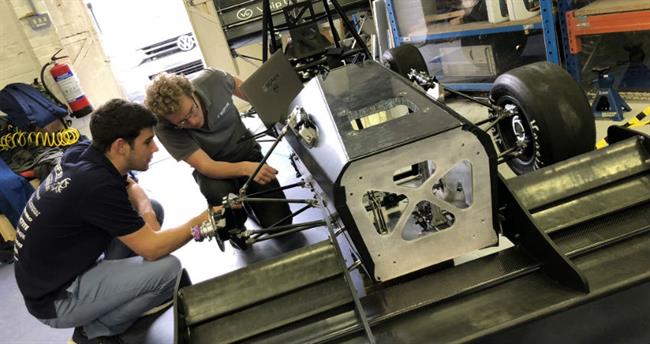
The monocoque scan followed and this was a key activity for the team as it has been the first year in SUFST’s history to use a monocoque design. The aim was to check how the manufacturing processes used for this year (bonding jig design) and folded structure have actually developed and if they meet the target of 2.5mm max deviation on the suspension pickup points. The results highlighted that the two top-side panels that form the main structure of the chassis were within 2mm of the modelled outer surface and the suspension pickup points were within 0.4mm of the design. On the other hand, up to 7mm of deviation could be observed on the backseat panel that runs from the driver’s shoulder height up to the front bulkhead. The 7mm was a planar deviation due to the bonding jig not constraining the panel rigidly enough during the assembly process. The findings from this analysis have been fed to next year’s technical team leads to ensure these issues are resolved during the development of the 2019 chassis and tooling.
The rear subframe was manufactured using its own welding jig that also attached to the monocoque to ensure correct alignment to it. During the manufacturing process, the main roll hoop (MRH) shifted backwards due to welding deformation and this was measured to be 10mm. Due to the nature of the design, the MRH is an isolated entity within the top of the chassis and only required trimming of the MRH bracing members. It was shown that the engine mounts had a deviation of less than 2mm from CAD with negligible deviation between mounts. With regards to the rear suspension mounts, the most critical part of the chassis, a significant design effort had been to ensure the welding jig constrained the position of these nodes effectively. The time invested into this clearly paid off as a maximum deviation of 0.5mm was found between all the rear suspension members and the front ones. This was inside the target of 2.5mm max deviation from front to rear suspension mounts.
The front and rear outboard suspension assemblies were scanned in their CAD position. Performing local best fits to these assemblies, the maximum deviation of these were within the tolerances specified in the manufacturing drawings. For future scans, a car setup rig could be used to pre-align toe and camber settings; at the same time a fixed full droop position (maximum rebound) could be implemented to aid alignment.
The final assembly scanned was the rear wing which was completed in two parts as the laser tracking station had to be moved to ensure line of sight was available. It was highlighted that the main plane of the rear wing had to be re-made as there was a crease on the pressure surface which would have had a significant impact on the downforce produced by the wing.

CONCLUSIONS
This activity proved very helpful to validate the design and manufacturing process of key components of the car: front wing, rear wing, chassis and subframe. It also provided the accuracy to perform detailed metrology analysis to report back to the future heads of department and improve the design for the 2019 season.
The support and advice offered by INSPHERE during the activity proved invaluable as it allowed the team members to concentrate on the process and not only on the pure metrology aspect of the activity. Team members focused on reporting potential causes for the deviation of certain components or assessing the accuracy of the tooling used.
To employ a value-added approach, future assessment could be split into two different sessions. First when the monocoque and subframe have been finalised; this would ensure that any changes required can be input into CAD and formally assessed rather than making changes to the final components without any detailed design and sign-off procedures, preventing potential reliability failures down-the-line.
The second session would be when the car is fully manufactured; this would be to assess the top-level integration of components in the car and highlight any potential reliability issues that could arise, for example, from incorrect routing of flexible lines or limited clearance between moving components.
The Southampton University Formula Student Team would like to thank INSPHERE for its support to the team and in this activity.
ABOUT SUFST
The Southampton University Formula Student Team (SUFST) is entering its 6th year in the competition and will compete in both Formula Student UK (Silverstone Circuit) and Formula Student East (Zalaegerszeg, Hungary) with the aim of finishing in the top 15 at both competitions. This year will be a revolution with the most experienced committee to date coming back from various industrial placements within Formula One, automotive and aerospace industries.
The SUFST is made up of over 80 undergraduate engineers from mechanical, aerospace and automotive backgrounds who design, manufacture and race an open-wheel race car against universities from all over the world. This group of innovative undergraduate students is always striving to develop the car and by doing so preparing themselves to be the world-class engineers and managers of the future.
For more information visit sufst.com
ABOUT INSPHERE
INSPHERE are experts in dimensional measurement and provide solutions to simplify and increase the productivity of measurement processes. They provide measurement automation solutions, sub-contract services, measurement training and consultancy across a range of industries including aerospace, energy, marine and automotive. Some of their latest projects include work with GKN Aerospace, Rolls-Royce CTAL, Airbus Defence and Space, and Formula One constructors. Their expertise and best-practice measurement approaches ultimately generate production efficiencies, enhancing manufacturing productivity.
For more information visit insphereltd.com or email info@insphereltd.com