With over 104,000 jobs supported by the UK aerospace industry, student and apprentice competitions are a valuable tool for bridging the gap between academia and industry – but to meet demand, we need to unlock their full potential.
Real-world experiences
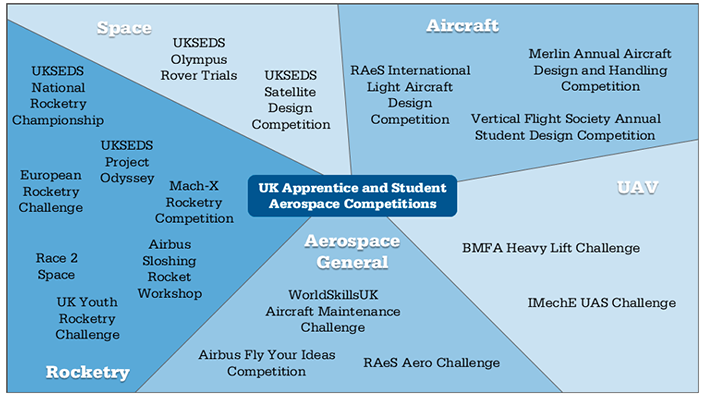
The competition landscape within the UK has a key strength in providing real-world exposure to aerospace processes and hands-on experience with hardware. Most practical competitions only cover the concept-to-prototype stages, however, leaving a gap in the in-service support and maintenance phases in these competitions.
These areas, which make up a significant portion of the aerospace product lifecycle, remain underrepresented despite their importance to the sector. There could be an opportunity to address this gap through in-service support and maintenance elements to competitions, drawing on experience of the successful WorldSkillsUK Aircraft Maintenance Challenge.
While there is strong representation across disciplines like airframe design, systems integration and rocket propulsion, aircraft engine systems lack a specific competition. There is a wealth of opportunities in the space sector, including competitions focused on satellite and rover development.
Participation in these competitions often requires teams to secure funding for entry fees and hardware, meaning external sponsorships and collaborations are essential. This financial challenge drives student teams to engage with industrial sponsors, providing invaluable networking opportunities and exposing students to the realities of project funding and resource management.
However, with the backdrop of a challenging economic environment, teams are likely to face increased difficulty in securing funding from cash-strapped academic institutions. Could there be an opportunity to establish a common funding avenue, supported by industry and institutions, to ensure accessibility and sustainability for all teams?
From design to flight test
Kristina Panikkar, project manager of the Unmanned Aerial System (UAS) Challenge, has a unique perspective on both the impact of these competitions and the work required to make them successful. Managing a competition that hosts over 300 students is no small feat, requiring a dedicated team of over 60 volunteers, many of whom are past participants.
“Volunteers do it for the passion – they really want the students to succeed,” she said. Panikkar's own participation in the challenge sparked her interest in UAS technology, eventually leading to a career in the field. She credits the challenge with providing skills and confidence that translated directly into her day-to-day work.
Similarly, Pablo De Felipe Schepers, now an engineer at hydrogen-electric aircraft developer ZeroAvia, reflected on his experience as a participant in the UAS Challenge. “Seeing a project go from design all the way to flight test was invaluable,” he said, emphasising how lifecycle exposure is often overlooked at university but vital in industry.
Although the technical skills from the competition were less relevant to his current role developing hydrogen-electric propulsion systems, the networking opportunities reaped great benefits. It was through one of his teammates that he first became aware of his current employer.
Despite these benefits, there are still areas for improvement. Iñaki de la Puerta Vallejo, an aerodynamics engineer at Airbus, mentors and supports early-career engineers. Graduates often need to build experience in programming languages and collaborative coding practices in the workplace, he said. These gaps could stem from students lacking access to these engineering competitions or signal an opportunity for competitions to adapt to further reflect these needs. Addressing these gaps presents an opportunity for competitions to evolve and meet the future demands of aerospace engineering.
Looking ahead
Maintaining and increasing industry support for these competitions is essential. Beyond providing financial resources, industry involvement fosters networking opportunities, showcases a wide array of career paths, and shines a light on small and medium companies in the aerospace sector. By collaborating with competition organisers, industry partners can help ensure that challenges reflect emerging technologies such as hydrogen propulsion, autonomous systems and sustainable aerospace technologies.
Panikkar noted that securing more sponsors for the UAS Challenge has enabled organisers to keep the competition relevant to evolving technologies. With greater support, competitions can expand their capacity to include more teams, broadening access to these invaluable experiences.
Professional engineering institutions play a critical role in helping universities embed these competitions into degree programmes. De Felipe Schepers’ experience highlights how students often juggle academic commitments alongside competition participation, which can be a significant challenge. By fostering stronger ties between academia, industry and competitions, institutions can help provide students with real-world experience that prepares them to be the next generation of the aerospace industry.
Want the best engineering stories delivered straight to your inbox? The Professional Engineering newsletter gives you vital updates on the most cutting-edge engineering and exciting new job opportunities. To sign up, click here.
Content published by Professional Engineering does not necessarily represent the views of the Institution of Mechanical Engineers.