Sometimes, however, that rigidity is a drawback – and in developing fields such as novel manufacturing methods or space exploration, something entirely more flexible might be desirable. Researchers at the University of Bristol and Queen Mary University of London hope their new morphing, shape-shifting ‘soft robot’ could one day offer an alternative.
Publicised in Advanced Materials in October last year, the system involves simple robots made of a material known as electro-morphing gel (e-MG) and a new control method. Images shared by the researchers show the material in a human-like shape, swinging across an overhead surface using its flexible body and limbs – but its fundamentally pliable nature means it could be reshaped and manipulated in countless ways, they claimed.
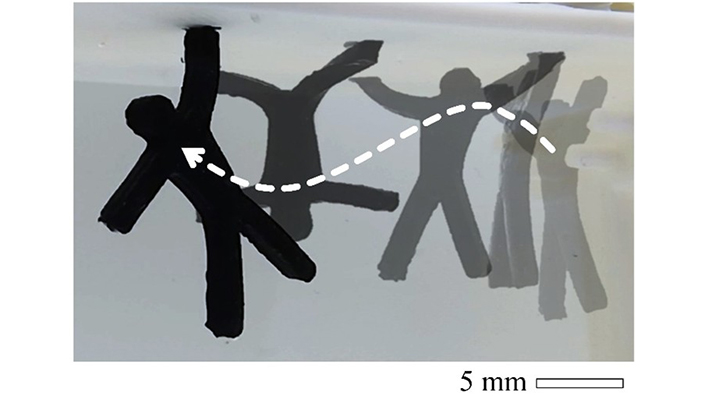
(Credit: University of Bristol)
“Think of the e-MG robot and future soft robots as Swiss Army knives; their adaptability can provide a diverse range of tools for situations where traditional robots may not be suitable,” said lead author Ciqun Xu, research associate at the Bristol School of Engineering Mathematics and Technology.
Likened to Spider-Man’s antagonist Venom, the electro-morphing gel is a soft matrix with conductive carbon particles distributed uniformly throughout. The material is first fabricated into a shape using moulding, before electric fields from lightweight electrodes are used to bend, stretch and move the object in ways that were previously difficult or impossible.
The control method could be as simple as dragging an electrode in one direction, Xu told Professional Engineering – or, as in the case of the gymnast-like demonstration, localised electric fields can be applied around limbs for more precise locomotion.
‘Electrokinesis’
The main advantage of the new system over similar soft robot projects comes from using electrodes for movement, said Professor Jonathan Rossiter, head of the soft robotics group at Bristol Robotics Laboratory and corresponding author of the recent paper. Magnetic fields have been used to manipulate other morphing robot systems using ‘magnetokinesis’, Rossiter said, but these either require heavy electromagnets that need cooling or external robotic arms to move permanent magnets. “You can only work in a very small space” as a result, he said.
By using super-thin electrodes – they could even deliver an electric field at just one atom thick, Rossiter suggested – the new ‘electrokinesis’ approach could be much lower weight and, the researchers hope, more practical as a result.
The work has been a “long process”, Xu said, including working out how to fabricate the material and how to control its morphing behaviour. Some of the capabilities were unexpected: “We didn’t think it could achieve this complicated deformation; we thought it would just be like simple bending or twisting. But in the end we figured out how to achieve more possibilities.”
For the swinging gymnast, electrodes were set up at a certain distance from the robot and changing voltages were applied to control it, but mobile electrodes could provide more options.
The project’s next step will be to explore applications, Xu said. The softness, adaptability and flexibility of the material could make it suitable for navigation through narrow channels or structures, he suggested, or handling fragile objects during precise fabrication processes.
The lightweight nature of the electrodes and the flexible manipulation they enable could make the system suitable for use in space, Rossiter added. In-space assembly has been explored for the deployment of large satellites and solar arrays in orbit, while specific applications mentioned in the study include gripping and delivering cargo, and flexibly exploring environments.
Biomedical applications could be another possibility, including wearable technologies integrating the soft robot system. Use on or inside the human body is an area where magnetic soft robots could have an advantage, however, as electric fields interact with human bodies.
Time to toughen up?
Other possibilities could be enabled by altering the e-MG material or the ways in which it is shaped. “There’s absolutely no problem with making them with different distributions of carbon nanoparticles,” Rossiter said. “You could put material into where the joints would be in the arms, and end where human joints would be – or you might have them on the fingers, so they can have these really long stretchy fingers but the rest of the body isn’t like that.
“Or we could put an endoskeleton inside… so that then you can apply loads. As this kind of robot could move around, apply loads, [it] could then support forces on its body, by being more robust.
“This is the first time that we’ve been able to manipulate solids in this way.”
Simple machines made using the material could be well-suited to uses where you want to limit connections into a system, he continued, potentially even replacing motors used for actuation in complex machines. “We would say, ‘OK, we’ve got our mechanism. We’ll just put a bit of this material inside, and then we’ll control it from outside.’”
The researchers might develop the material further, Xu said. “The current version is soft and deformable, but it also has some limitations – like it’s a bit too soft; it could not handle heavy working loads. And also the material itself is not biodegradable. We could use other materials to change the properties.”
The team hopes the new system could tackle challenges in soft robotics including response time, complex shape changes and independent manipulation. Strength, speed, reliability and precise motion are likely to be ongoing challenges, however, with improvements needed before any practical applications.
Want the best engineering stories delivered straight to your inbox? The Professional Engineering newsletter gives you vital updates on the most cutting-edge engineering and exciting new job opportunities. To sign up, click here.
Content published by Professional Engineering does not necessarily represent the views of the Institution of Mechanical Engineers.