Engineering news
Led by researchers at the University of Bristol, the work – published this week in the Journal of the Royal Society Interface – replicates the key features of a system of ‘molecular motors’.
Known as actomyosin, the coordinated activity of thousands of these protein complexes makes muscles work in the human body. Under increasing load, human muscles can recruit more of the ‘motors’ to provide more strength.
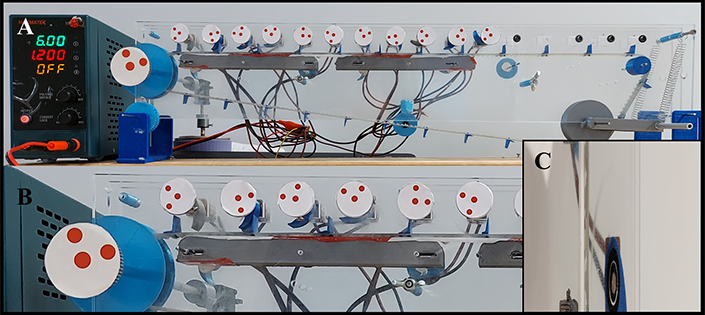
Rather than modelling those intricate molecular interactions directly, the Bristol team created a simplified system in which actual motors interact only through brief mechanical contact within a carefully designed geometry.
(Credit: University of Bristol)
After building an experimental tabletop model using small electric motors arranged like real muscle proteins, the researchers found that the device ‘self-organised’ into coordinated travelling waves of motion and automatically adapted as the mechanical load increased, just like human muscles.
“The motors aren’t ‘talking’ to each other directly – each one pushes on a shared ‘backbone’ structure, which changes what the others feel,” said team leader Dr Hermes Bloomfield-Gadêlha, senior lecturer in applied mathematics and data modelling.
“Over time, that feedback causes them to fall into coordinated patterns on their own – a bit like rowers synchronising their strokes, or the classic synchronisation seen in pendulum clocks.”
The physical demonstration was built using small electric motors combined with 3D-printed plastic components and laser-cut acrylic.
In soft robotics, the principles could help engineers design adaptive artificial muscles that organise themselves naturally rather than relying on complex control systems, a Bristol announcement said.
“On the engineering side, we’re interested in whether these ideas could help design artificial muscles or soft robotic systems that adapt automatically,” Bloomfield-Gadêlha added.
“From a biological perspective, it also raises questions about how much of muscle behaviour depends on motor chemistry and how much comes from the organisation of the system. Understanding that balance could help us better understand muscle health, disease, ageing and conditions such as muscular dystrophy.”
Want the best engineering stories delivered straight to your inbox? The Professional Engineering newsletter gives you vital updates on the most cutting-edge engineering and exciting new job opportunities. To sign up, click here.
Content published by Professional Engineering does not necessarily represent the views of the Institution of Mechanical Engineers.