Aware of the urgent need for the UK to enthuse more young people about careers in science, technology and engineering, community leaders in Stoke-on-Trent and Staffordshire invited the Institution’s CEO, Stephen Tetlow MBE, to take part in a debate to identify ways to address skills gaps locally.
The debate brought together representatives from local authorities, the Stoke-on-Trent and Staffordshire Local Enterprise Partnership (LEP), and Staffordshire Chambers of Commerce.
Held at the Staffordshire Chambers of Commerce in Stoke-on-Trent, the aim of the debate was to provide an opportunity for professional bodies, universities and businesses in the area to work together. It was organised by the LEP’s business growth and innovation lead and board member Jonathan Dale.
Jonathan said: “Events like today are what it’s all about. If we can work together to build our area’s engineering skills that will translate into more jobs, a more highly qualified workforce and a thriving economy for Stoke-on-Trent and Staffordshire.”

Jonathan Dale, Sara Williams and Stephen Tetlow MBE are working together to address engineering skills gaps in Stoke-on-Trent and Staffordshire
As part of the debate, Stephen presented insights and statistics on the growing engineering skills gap. He explained that some of the problems needed to be addressed by schools, an example being the high number of vacant posts for physics teachers across the country.
“We have a massive wastage in schools of young people who might be excited by science and technology,” Stephen said.
He added that only two in every 100 boys, who took physics at GCSE, went on to take up an engineering degree. He highlighted that the situation was worse among girls who took GCSE physics, where only one in 200 went on to study engineering at degree level. He explained how it important it was to fix the 'leaks' in the pipeline that leads engineers and technicians towards professional registration.
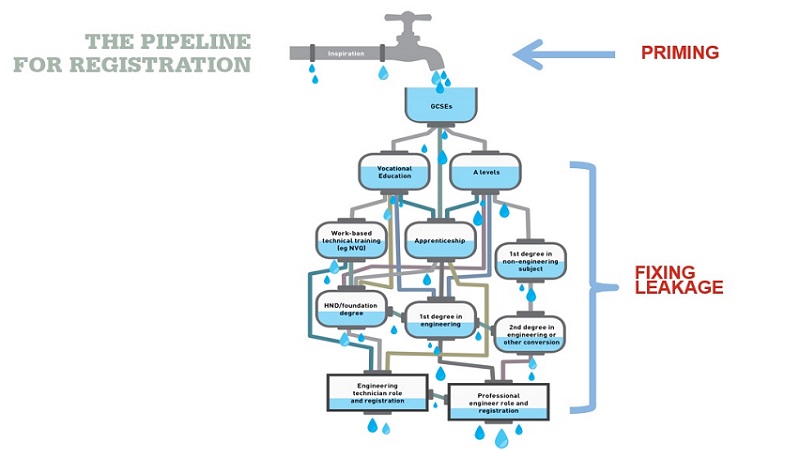
He explained that the UK needed 87,000 new Level 4+ engineers a year to meet demand – but that the UK was producing only 51,000. He added that the UK needed to produce 69,000 Level 3 Engineering Apprenticeships each year, but at present was only providing 23,500.
“Overall, we are producing half the number of Engineering Technicians and graduates that the country needs, not only to grow GDP, but to replace the demographic time bomb as older people retire,” Stephen said.
“Many companies are saying to us that their biggest impediment to growth is the supply of skills and we need to do something very serious about this as a country.”
Following the meeting, the Institution and the Staffordshire Chambers of Commerce plan to develop a local Young Engineers Network. The network will support young people in the early stages of their careers, particularly those who are working for small or medium enterprises.
Follow up discussions are also planned to decide how best to promote engineering as a future career choice at keys points, such as when families are choosing their schools and when young people are considering which subjects to take.
The LEP has also set up an engineering careers page on their website to inspire more young people to consider a career in engineering.
Staffordshire Chambers of Commerce CEO, Sara Williams, said: “We know that one of the worst affected areas for skills shortages is the engineering sector. It is essential that efforts are focused on attracting young talent into this sector to tackle this skills gap head-on and ensure Staffordshire’s engineering firms can grow and thrive.
“We are delighted to be working with the Institution of Mechanical Engineers to create a Young Engineers Network, so that talented young engineers are supported, developed and their skills retained within Staffordshire’s engineering businesses.”
Stoke-on-Trent City Council is also working hard to drive up mathematics standards in schools and has allocated £500,000 to an innovative scheme, which has been match-funded by the Bet365 Foundation.
The programme will focus on the training and retention of specialist maths teachers in the area and will join up the work of schools, colleges and universities.
The scheme aims to improve the prospects for children in Stoke, where traditional industries such as pottery have declined in importance. Stoke is ranked as one of the five worst-performing local authorities in the country for maths.
The scheme will support the professional development of maths teachers and enable trainee teachers from Keele University to build their skills in local school classrooms. It aims to get 70% of pupils achieving an A*-C at GCSE maths in the next three years, up from 59% at present.
The funding will also be channelled towards the further development of leadership skills among mathematics department heads.
The project is also offering recruits £2,000 per year for three years, towards paying off tuition fees and a further relocation payment of £2,000.