Convenient contours: Millbrook provides both hills and flats
Millbrook has something of an image problem. Most people think of it as the super-secret home of new car testing, where camouflaged, next-generation vehicles are put through their paces on its extensive network of tracks. Such activities do constitute a good part of the business. But Millbrook, these days, is so much more.
Correcting that misconception is one of the first tasks for Alex Burns, the ex-Williams Formula One team leader who has recently taken up the reins as chief executive at Millbrook. He knows that for the business to progress into new markets and countries, there needs to be greater awareness of the suite of services it offers.
“Millbrook is a good brand. People certainly know about the tracks, but not about the range of other engineering services we provide. There’s a lot that happens here. And that’s an opportunity – to communicate more broadly just what we can do,” he says.
Millbrook has a rich history, having been established in the 1960s by the US carmaker GM. While the new M1 motorway near Luton provided the opportunity for straight-line, constant-speed running, GM wanted a dedicated facility where it could prove its Vauxhall and Bedford models on both hills and flats. The location of Millbrook, in Bedfordshire, and the area’s geography, were identified as ideal. So GM constructed 70km of straight and circular tracks there, along with stretches of road surface such as Belgian pave.
For many years, the efforts of the small staff team based at Millbrook were consumed by Vauxhall cars and Bedford trucks, buses and military vehicles. But in 1988 a new company, Millbrook Proving Ground, was formed to trade independently as a subsidiary of Group Lotus. Further change came in 1993, when Millbrook was separated from Lotus by transferring its shares to GM Holdings UK. The company continued to flourish as an independently managed business, with vehicle design activities including crash mitigation, emissions control and component durability added to core track-
based services.
But in 2013, GM announced plans to consolidate its proving-ground activities in Germany, so a new owner for Millbrook was sought. That process came to fruition at the end of last year, when Millbrook was acquired by private equity group Rutland Partners. A management merry-go-round followed, with Rutland bringing in Burns to take Millbrook into a new era.
Millbrook was a success under GM ownership, with large investments made over the years. But the structure meant that some rival carmakers were reluctant to put business its way. Now, without links to an individual OEM, Millbrook is free to pursue new clients and make independent investment decisions.
That freedom provides exciting opportunities, says Burns. “I wanted to come here because I realised there was potential. GM had done well in terms of diversifying the business, and there has been steady growth. But independence gives us an opportunity to do more. What attracted me was the chance to take the business through the next stage, and to do more with the intellectual property that is created. That wasn’t always appropriate in the past – but it is now.”
Millbrook was just the sort of acquisition that Rutland is known for. The London-based outfit has carved out a reputation as a turnaround specialist, investing in businesses with growth potential. Its partners did an enormous amount of due diligence on the acquisition, spending several months tying up the multimillion pound deal. Consequently, Burns says, Rutland knows Millbrook well, and he envisages the new owner as being hands-on in terms of its management. “I expect Rutland to be quite engaged. At present, I speak to them on at least a weekly basis. They don’t necessarily want to be involved in the decision-making – but they are represented on the board.”
A new owner often prompts nervousness among staff, especially when an engineering-related business is sold to a financially oriented organisation. Burns says this apprehension is to be expected. However, he insists that Millbrook’s employees have welcomed the change of ownership. “That was my main nervousness coming here – that there would be uncertainty and fear among the staff. But that hasn’t been the case. The employees recognise the opportunity and see that there is a lot to be done with Millbrook. There is a bubbling-up of ideas and enthusiasm.”
The reason for that optimism is simple – money. Rutland has bought Millbrook to invest in it, and has been clear in saying that capital is available, says Burns. That investment will underpin a move away from primarily serving the needs of GM to assisting a range of clients and industries. The business now has total control of its destiny, he says. Capital investment decisions will be based purely on Millbrook’s needs, rather than being made in the context of a large multinational. And, when it comes to decision-making, the new ownership allows Millbrook to become a more nimble outfit.
With money available, staff have been quick to present Burns with a long list of requests as to where investments should be made, he says. In terms of the existing business, several assets, including some buildings, need updating. The emissions testing laboratory has been identified as a specific facility that is likely to be upgraded, moving it from single-axle to dual-axle, and potentially to independent four-wheel drive capability. The tracks themselves are in reasonable condition, and are unlikely to
require much investment, bar the usual maintenance.
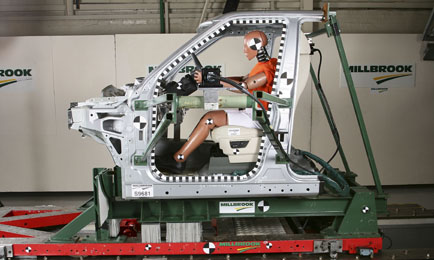
Safety first: Services offered include crash testing
In terms of new business, Burns has identified low-carbon transport as an area where progress could be made. “Millbrook has already done a lot in terms of electric and hybrid vehicles, but I think there is the opportunity to build on that and to offer a broader range of services,” he says.
What about areas outside of automotive, such as aerospace? “Automobiles, trucks and public service vehicles, such as buses and even road sweepers – that’s our first port of call. I want to make sure we are serving all transport sectors. We do bits and pieces in aerospace, but the offering here isn’t geared particularly strongly to that sector. So to think much beyond transport is probably a little premature.”
Geographic expansion could also be on the cards. While track testing is restricted to the UK by the location of the physical infrastructure, Burns doesn’t rule out carrying out some engineering services for overseas clients in places such as China or the US. On such potential activities, he says: “We are gathering all the information we need to do a strategic review.”
In terms of individual customers, he hopes that GM will remain an important client for Millbrook. While the US carmaker is investing around ¤230 million over the next four years in new facilities at its European product development centre in Rüsselsheim and at its proving ground in Dudenhofen in Germany, Burns thinks that Millbrook is still ideally placed to carry out some work for the company.
“GM has grown capability in Germany – but we have certain niche services that it doesn’t have elsewhere. GM is also launching new models and platforms, and that potentially drives work that could come our way.” But he welcomes the chance to attract new customers, saying that, in business, it never makes sense to keep all eggs in one basket.
When PE visited Millbrook, Burns had been in his role for less than a month, so some plans for the business were still in their formative stages. Over the coming weeks, he will formulate a detailed strategy that sets out Millbrook’s growth potential in the medium term. Rutland has a reputation for taking a slightly longer-term view on its investments than other private equity groups, but Burns is under no illusions – the new owner is in it to make money. “That’s fine,” he says, “but that won’t happen through clever financial engineering or anything like that. Rutland’s style is to take on companies that need investment and to make them stronger businesses into the future.
“They want us to make Millbrook a fundamentally better business. That’s how they make money for their fundholders. Rutland’s ownership is a new chapter in Millbrook’s history – it’s by no means the final chapter.”
Far more than just test routes
Millbrook is best known for its durability test tracks, which include on- and off-road routes and a host of specialised surfaces. But it also offers a full range of engineering services.
These services include: vehicle engineering and dynamics; powertrain development capabilities such as engine test and development; exhaust emissions and fuel consumption monitoring; climatic and environmental testing; and advanced propulsion charging and refuelling.
One recent investment has involved the purchase of a portable emissions-measurement system (PEMS) – an outdoor laboratory that can be fitted on to the back of a car or a bus to provide realtime pollutant measurements in real-world conditions.
PEMS will soon become part of European emissions legislation – it is already a requirement in the US. The system allows measurements to be taken as vehicles are repeatedly driven over several representative drive cycles – which can include urban driving, Alpine routes and higher-speed motorway driving, providing information that is virtually impossible to
replicate elsewhere.
The system is attached via tubing to the vehicle exhaust, with analyser stacks measuring and monitoring the flue gas to provide accurate g/km measurements for CO, CO2, O2, NO, NO2 and hydrocarbons.
“The technology is flexible,” says Chris McGurn, a powertrain engineer at Millbrook. “It is quick and easy to bolt on to a range of vehicles that cannot be tested in the laboratory owing to
their size.
“The technology offers a complete profile of emissions in real-world conditions.
“All test work that can be done in the laboratory can now be done on the road – with full repeatability.”
Potential further applications lie ahead, too – the system is being developed to measure methane and particulates, and for use on a wider range of transport systems such as boats and trains, and on generators.
Track record: Alex Burns

Alex Burns is a mechanical engineer who holds an MBA from Cranfield University.
He spent 14 years at the Williams Formula One team as chief operating officer and then as chief executive. During this tenure, Burns set up Williams Advanced Engineering, which brought F1-inspired, low-carbon technology to the commercial and passenger vehicle markets, and led the design and manufacture of five hybrid supercar prototypes.
Before joining Williams, Burns spent 12 years in various senior roles at Meggitt – which specialises in extreme-environment components and sub-systems – having started his career at Westland Helicopters.
Millbrook’s former chief executive, Miguel Fragoso, left the company in February to pursue other interests.