“You can't just nip down the road to pick up spare parts,” says Sarah Capperauld, technical director at construction engineering firm Sweco. “You have to make sure that you plan for and design for the fact that you're in a very remote location.”
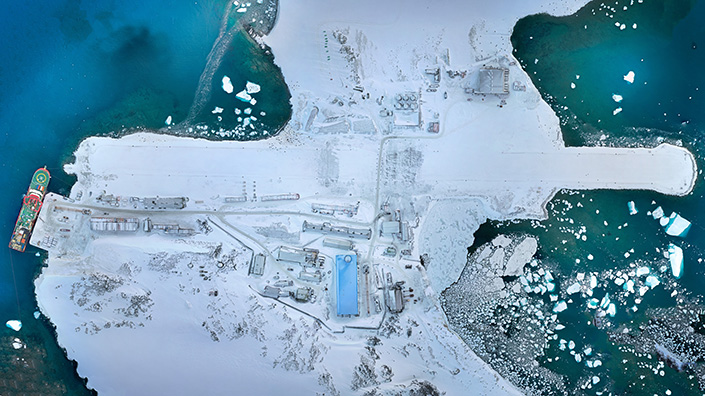
That remoteness was just one of the hurdles as Sweco partnered with BAM Nuttall, the British Antarctic Survey (BAS) and technical advisers Ramboll on the design and build of the new Discovery Building, a science and operations hub that began full operation in May this year. The facility also consolidates the functions of other buildings at Rothera Research Station, combining them to minimise carbon and energy consumption.
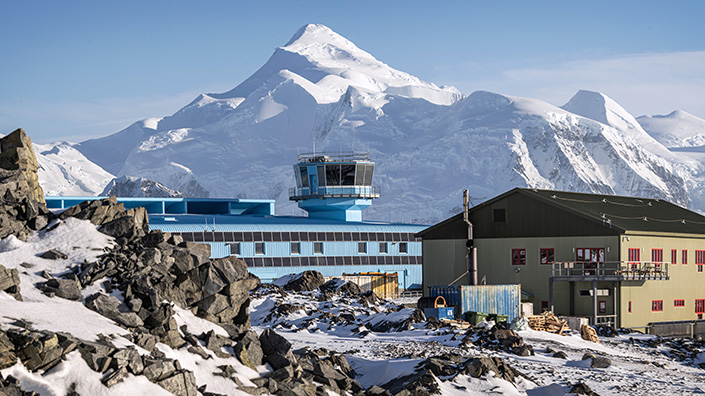
“It acts as their comms tower, their lookout tower for the aircraft landing and taking off. They have their medical centre, they have recreational facilities, their central stores, which store all of their dry goods. They also have a freezer store,” Capperauld tells Professional Engineering – just one of the project’s surprises.
“Because of where it's situated on the Antarctic Peninsula, it doesn't experience true extremes like you would expect right at the South Pole,” Capperauld explains. That means summer temperatures of about -5ºC to 6ºC, down to about -20ºC in winter – although the area is far from immune from climate change, and has seen temperatures way outside the norm this year.
Workshops, office spaces, a gym, a training climbing wall for expedition teams and a sauna are also housed in the Discovery Building. An energy centre generates and distributes the station’s power, and a potable water store does the same. It is, Capperauld says, “the heartbeat of the station”.
(Credit: Matt Hughes BAS)
That heartbeat is healthier than ever, according to Breeam, which awarded the £100m facility an Outstanding accreditation – the UK’s highest standard in sustainable construction, awarded to just 1% of accredited projects worldwide.
“This is an historic achievement,” said BAS director Professor Dame Jane Francis, who formally opened the building in January. “The rating reflects the dedication of everyone involved, and our absolute commitment to polar science and operations, which support our journey to net zero.”
The project also recently won three awards at the British Construction and Infrastructure Awards 2026.
Delicate balancing act
Despite relatively mild temperatures compared to the South Pole, the frequent cold and constant isolation of Rothera meant a delicate balancing act between innovation and reliability on the Discovery project. “BAS are very conscious that managing and maintaining systems that are a bit ‘out there’, a bit too innovative, can present complexities and challenges to their operatives,” Capperauld says.
“They have to think about not just building a sustainable and efficient building, but how they are going to operate, manage and maintain that... there is a bit of a trade-off sometimes because of that, but it also causes you, as designers, to think outside the box.”
The centre’s server and UPS (uninterruptible power supply) rooms are a good example, she says. Both produce heat and would typically require a refrigerant-based cooling system, but the design team saw an opportunity to minimise both maintenance and environmental impact.
“We came up with what was essentially quite a simplified ventilation solution, whereby we remove the heat from the room through an extract system and then put that through a… variable volume bypass damper, to feed the heat back into the supply air stream,” Capperauld says. “We were essentially reusing heat that would have otherwise been wasted.”
Another aspect combining simplicity and innovation is the building’s wind deflector, which Capperauld describes as a “big blue sail”. The passive system channels and redirects the prevailing northerly wind down the south side of the building, where snow would otherwise drift, potentially as high as the building itself.
“It actually scours the snow away from the south side of the building and reduces the amount of snow clearance that needs to be done, which was another one of the key performance criteria from BAS,” Capperauld says.
“The winter team is a much-reduced number of people. Whenever the summer team come, usually one of their first activities is to clear snow from around the station. So whilst they still have to do that for a lot of the other buildings, the operational requirements for the Discovery Building have been significantly reduced because of the wind deflector. They've been able to ‘de-winterise’, as they call it, and get into the building much more quickly.”
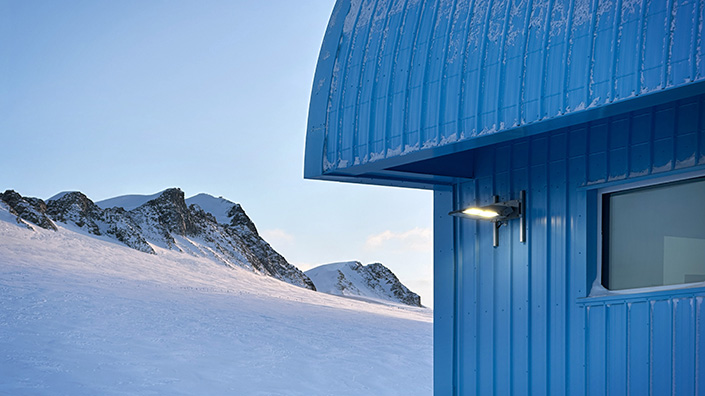
Part of the wind deflector, which directs air down the south side of the building (Credit: Matt Hughes BAS)
Closing the windows
Another solution came in response to an unlikely sounding problem on the southernmost continent – workers leaving the window open. “People would open windows because it might get too warm in the room,” Capperauld says, but “everybody’s feelings of warm and cold are quite subjective. So people would open windows and then leave windows open with the heating cranked up.”
That is far from ideal from an energy conservation perspective, so in the new building the team installed mechanical ventilation instead, with built-in heat recovery. Occupants cannot open the windows, but the smart ventilation controls should also optimise comfort.
Temperature stabilisation and heat recovery is also a feature of the station’s new combined heat and power (CHP) system, which Capperauld describes as a “huge part” of its efficiency and sustainability credentials. Despite currently running on diesel-like marine gas oil, the system captures and reuses heat that would otherwise be lost, improving overall energy efficiency while reducing fuel consumption.
“All the existing buildings were previously just supported on marine gas oil-fired boilers, and generators that were just generating power with no heat recovery. So the introduction of CHP engines is obviously a step towards a more sustainable solution,” Capperauld says.
“We do have thermal stores, which work to provide a buffer between the CHP electrical generation, so then we can store some of that useful heat to use whenever we have the demand on the thermal side.”
‘A big accomplishment’
Modern methods of construction were “critical” to the project as the climate limited building work to six months at a time, Capperauld says. “We had to basically ‘build it before we built it’ using the digital modelling tools that we have available to us – Revit, Navisworks [both from Autodesk] – to essentially construct the building, do clash detection, and make sure that everything will fit in the space.
“The design development included off-site prefabricated modules, including prefabricating pipe/duct sections, services modules along corridors, prefabricated elements of the plant rooms, including boiler skids, pump and pipework assemblies, fire pumps and the CHP engines. Everything came in skid form and was basically ‘plug and play’, minimising time on site.”
Construction began in 2019 and finished this year. “We've achieved quite a lot in that time. And that's mainly down to the way that we've looked at building it before we built it, and maximising opportunities for modularised construction and prefabricated modules.”
(Credit: BAS)
The building will now sustain the UK’s presence in Antarctica, as BAS scientists carry out marine research and track the effects of climate change.
“It feels like a bit of a marathon that we've all been through,” Capperauld says. “It's been nice to be on that journey and to see it through to completion, and to now see BAS operating and working in the building and using it for the purposes that were intended. So that's really, really good. It feels like a big accomplishment.”
Want the best engineering stories delivered straight to your inbox? The Professional Engineering newsletter gives you vital updates on the most cutting-edge engineering and exciting new job opportunities. To sign up, click here.
Content published by Professional Engineering does not necessarily represent the views of the Institution of Mechanical Engineers.