Humanoids started to step out of research labs into commercial applications earlier this decade, but that journey is now rapidly picking up pace, as illustrated by a major announcement in January this year. At the Consumer Electronics Show in Las Vegas, long-time sector leader Boston Dynamics unveiled the latest generation of its Atlas humanoid and revealed plans to deploy it in Hyundai factories.
Described by the firm as an “enterprise-grade humanoid robot that can perform a wide array of industrial tasks, from material handling to order fulfilment,” the new Atlas is “the best robot we have ever built,” says CEO Robert Playter. “Atlas is going to revolutionise the way industry works, and it marks the first step toward a long-term goal we have dreamed about since we were children – useful robots that can walk into our homes and help make our lives safer, more productive and more fulfilling.”
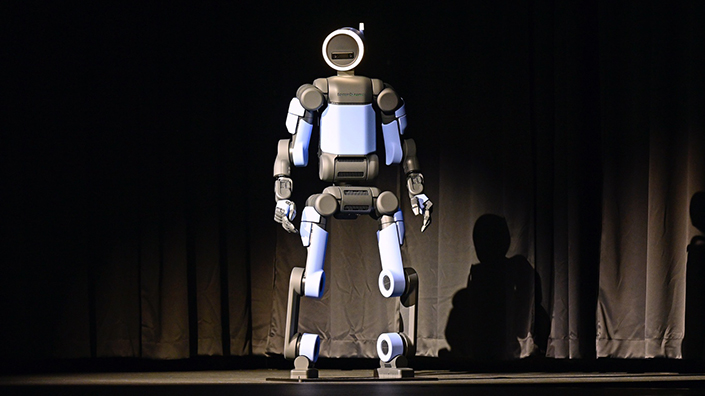
The latest generation of Boston Dynamics' Atlas humanoid robot (Credit: Boston Dynamics)
Widespread deployment of humanoids looks practically guaranteed for the first time ever, and Boston Dynamics is far from the only player. While Atlas once stood head and shoulders above the entire sector, dozens of competitors are now introducing their own bipedal products to the market.
Estimates vary for the true number in the field – consultancy McKinsey & Company identified 50 worldwide in October last year, while China’s economic planning agency said more than 150 were operating in its country alone, according to a November article on The Verge – but demonstration videos are unavoidable online. Well-known entrants include the Tesla Optimus, the Figure AI line, the G1 and H1 from Chinese firm Unitree, the 4NE1 and 4NE1 Mini from German company Neura and the Agility Digit, which is being tested by Amazon.
The online videos showcase flashy skills, including dancing, somersaulting and even boxing, while company bosses promise completion of useful tasks with human-like abilities. In China, the high-kicking T800 from Shenzhen’s Engine AI has even been filmed patrolling with police officers.
Important breakthroughs were needed to get to this point. How did engineers manage it – and can the robots live up to creators’ promises?
Taking control
Watching 21 humanoid robots compete in a half-marathon or Atlas perform a flip, it could be easy to forget how far the field has come in recent years. Until roughly 10 years ago, the state-of-the-art was Honda’s Asimo, which – while impressive at the time – relied on preprogramming for its most complex actions, and could only make small, timid steps.
The biggest contributor to modern machines’ more advanced abilities are new AI control methods. While previous humanoids used a technique known as zero moment point control, which involved complex calculations to keep the centre of gravity above the foot, newer machines use model predictive control, which can predict and react to future events.
Virtual training in simulation programs and a chatbot-like approach to responding to orders are also making them far more capable. The Helix 02 neural system from California-headquartered Figure connects all vision, touch and body awareness sensors directly to all actuators, for example, using a controller trained on more than 1,000 hours of human motion data and simulation-reinforced learning.
The latest version of Atlas is able to move parts around Hyundai factories, thanks to higher level perception and reasoning from AI, says Dr Ingo Keller, head of robotics at The National Robotarium, the UK’s centre for robotics and AI in Edinburgh. “You get more flexibility in what you approach,” he says. “You don’t have to have perfect knowledge about the objects you’re handling. You don’t have to have perfect knowledge about your environment.”
.jpg?sfvrsn=ae535811_0 "Ingo Keller (2)")
Dr Ingo Keller of The National Robotarium says AI allows a greater degree of flexibility
Control and AI advances were also singled out by Professor Kaspar Althoefer, a roboticist at Queen Mary University of London, as the most important advances enabling impressive robotic movement, helping machines cope with the dynamics of movement in the real world.
The overall field of sensors has “moved forward quite a bit”, he continued, but there is still a strong emphasis on vision. “To see the world, understand the orientation and position of the robot with respect to that world and then make appropriate adjustments to the movement so that the robot doesn’t fall over… there is amazing stuff happening there.”
In the Figure 03, for example, new cameras provide a 60% wider field of view and twice the frame rate of the previous system, providing Helix with a “denser, more stable perceptual stream”. The robot’s hands even have embedded palm cameras, allowing it to take a close look at objects it is picking up or explore the back of a cupboard that would otherwise be out of view.
Degrees of freedom
Seeing is not everything, however. Despite the fundamental importance of AI and vision systems to the capabilities of modern humanoids, the prominent robotics experts agree on the importance of hardware advances. Recent years have seen a drive towards reliability, turning devices that might previously have stagnated at the prototype stage into artificial assistants ready for industrial use.
Dexterity is a key element of practical deployment, and today’s robotic hands are remarkably capable. Popular demonstrations include folding laundry and moving crockery, both aided by tactile sensors in the ‘skin’. Higher degrees of freedom, such as the 22 found on the third-generation Tesla Optimus hand – twice as many as the previous version, and approaching the 27 used by humans – are also enabling more complex movements.
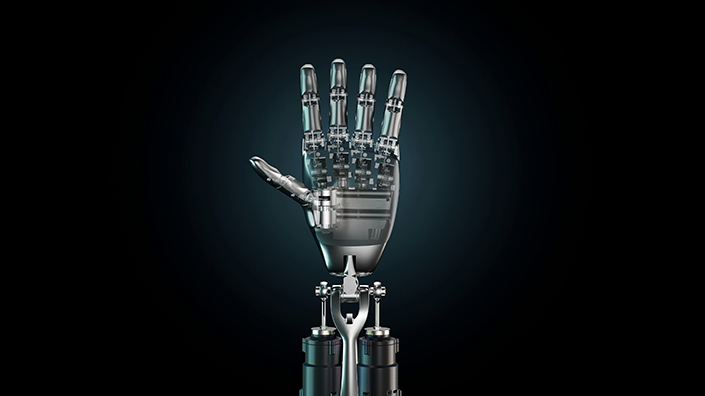
A look inside the hand of a Tesla Optimus robot (Credit: Courtesy of Tesla Inc)
Better hands have been made possible by two key developments, according to Dr Steve Davis, senior research fellow in robotics at the University of Birmingham: miniaturisation of electric motors and position sensors, and development of tactile sensors for the sensation of touch.
Operational director of The Birmingham Institute for Robotics, Davis has built multiple human-like hands during his almost 30-year career. “Our motivation for looking at humanoid hands is the fact that this is a really good multi-purpose tool,” he says. “You can thread a needle or you can carry a 20kg suitcase.”
That adaptability is a vital part of the android dream – by giving robots the same flexibility that humans have, developers hope they will be able to tackle a similar range of tasks.
There are drawbacks, though. Humanoid hands are very difficult to engineer, Davis says from experience, and they break “incredibly easily”. They are also expensive to make, despite additive manufacturing helping to bring down some costs.
As with some current developers, Davis has pivoted to something simpler, with four ‘fingers’ arranged in two sets of two. Other projects have used just three or even two fingers, similar to industrial grippers but with some human-like capabilities integrated – the ability to detect forces, including slip, and then adjust the grasp. This approach can make robotic hands more robust while still providing useful capabilities.
The human touch
Despite the impressive features of some human-like hands, the future of manipulation is a topic of some debate among researchers. “There is still a question as to whether we would even need anthropomorphic hands,” Keller says. “We are, mindset-wise, going into humanoid hands – but whether this is the right solution in the end is a different story. I also can foresee situations where you might have a humanoid body, but you might want to switch out the end effector… maybe it’s an anthropomorphic hand here and two finger grippers there, depending on the task.”
The question is far from answered – and it is a vital area of focus. Keller is blunt: “If you take the dextrous manipulation bit out of the picture, what is left? Not that much, in all honesty.”
Perhaps the future lies in a hybrid between humanoid hands and industrial grippers, similar to those explored by Davis. “It really depends on the application,” he says. “One of the drivers behind humanoid robots is that you can put them into a world that is built for humans and they can behave in exactly the same way – but does your humanoid robot need to have four fingers and a thumb for a lot of the tasks it’s doing? Probably not.”
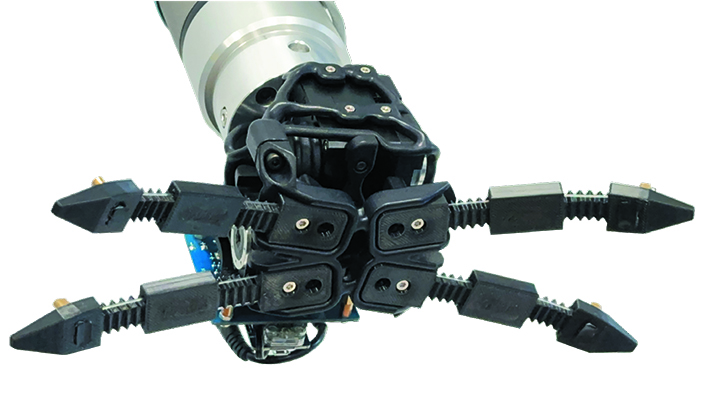
Dr Steve Davis has pivoted to a design with four ‘fingers’ arranged in two sets of two
More work is clearly needed if humanoid hands are ever to compete with our natural appendages. “They still lag way behind anything that’s achievable by humans,” Davis says. “Think about the sort of the sensitivity we’ve got in touch… it’s many magnitudes better than anything that’s achievable with a robot hand.”
The other challenge that engineers are tackling is hand control, made difficult by the often high number of coupled joints. “10 years ago, we were looking at controlling robot hands by programming and telling them exactly what the position of each joint needed to be, to pick up an object. Now we’re moving more to teaching by demonstration,” says Davis.
Boston Dynamics is using this approach on Atlas, which has autonomous, teleoperation and ‘steering’ control modes. The company’s large behaviour models collect data from both physical and virtual teleoperation, before processing that data into a machine learning pipeline and training a neural network ‘policy’. That policy can then be evaluated on a set range of tasks.
“You’re not just replicating what a person’s doing,” Davis says. “Their system will probably also allow that robot to learn, assess how well it’s done it and pass that on to future generations of the robot.”
Embodied intelligence
Hopping, flipping, punching – many of the most striking humanoid demonstrations have come down to impressive body dynamics, enabling robots to move flexibly or remain stationary as needed. In some striking videos, humanoids such as the Unitree G1 even manage to balance and leap up from the floor despite facing a barrage of punches and pushes from human testers.
Not everyone is impressed, however, with online commenters frequently pointing to the rehearsed or preprogrammed appearance of athletic demonstrations. AI control methods have provided a lot of the puzzle pieces for more natural movement, but human- or even animal-like movement will likely involve a more sophisticated approach to structure, according to Althoefer.
Researchers are working on “embodied intelligence”, he says, for which they will try to “instil intelligence” into the structure itself.
“Our bodies are made from rigid bones, but not only that,” he explains. “There is also soft tissue in between. There are muscles that can stretch and adapt. These are not electric motors – and I think it shows because if you look now at these robots, even though they are modern and they become more and more fluid in their movements, they’re still quite clunky. How can we shape the structure, look at the stiffness of the structure, the appropriate stiffness for certain tasks – for example, locomotion – to reduce the amount of control you need?”
Doing so could be the key to smoother, more balanced and natural movements – and Althoefer believes soft materials could hold the answer. “You could have a rigid structure but then have soft interfaces between the bones, as we have also in our body; have the feet shaped in a way that they can dampen the impact when you step on to the ground,” he says.
As with hands, human-like features might not necessarily be the best option for all humanoid feet. Althoefer mentions recent research carried out by the Morph Lab at Imperial College London and the University of Pisa, which saw engineers develop a mountain goat-inspired robotic hoof that passively gains mechanical traction in steep terrain.
“Rather than relying on sensors or complex control, it uses geometry and compliance to form stable connections with the ground and prevent slip,” the lab says in a video.
Continuous operation
Of course, humanoid robots can only complete meaningful work if they have the energy to do so. Continuous operation could be the difference between perpetual R&D and the economic viability of long-term deployments, and some companies are including the features to enable it.
Automatic battery swapping, as seen on Atlas and the Walker S2 from Chinese firm UBTech, is one such feature. Based around two batteries, UBTech’s system “consists of real-time battery monitoring management and dynamic power management, which enables both batteries to charge and discharge simultaneously,” says UBTech spokesperson Wenyi Rao.
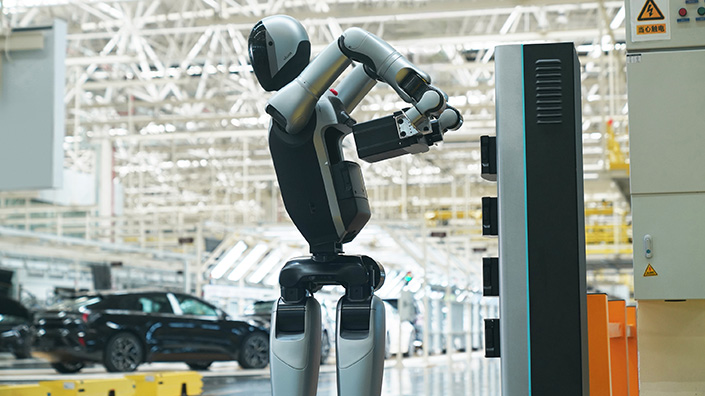
The UBTech Walker S2 swaps one of its battery packs
A sped-up video shows the S2 moving its arms behind its back, removing one of the two batteries, placing it in a charging tower, then removing and installing a charged battery. The swapping technology uses “high-precision body positioning and adaptive control algorithms,” Rao says, “enabling the humanoid robot autonomously to complete battery alignment, insertion and removal through dual-arm coordination, achieving a hands-free battery-swap process with no human intervention”.
Combined with better mobility, continuous operation will be the key to reliable systems that do not have to remain in one place, Keller says. That could free humanoids from limited ‘work cells’ and open up wider workspaces, thanks to their increased capabilities and improved flexibility.
Safety will be another key factor when affording robots greater freedom. “Close collaboration between people and humanoids will require multilayered safety architectures combining vision, tactile sensing, proximity detection, and force-limited actuation, which puts guardrails on the amount of pressure robots can exert,” McKinsey said.
Manufactured use case
For now, the safest applications will likely involve deploying humanoid workers in environments away from people. Highly automated factories are an obvious choice – but the increased complexity and potentially higher cost of humanoids compared with classic automation will be a key consideration for any manufacturers looking at deployment, which in some situations will already be fraught with sensitivities around replacing human workers.
“If we get to a point where a factory is completely automated, why would that factory have humanoids?” asks Davis. “We can make much more efficient automation systems that are nothing like a human, so I don’t see that being a long-term solution… I just think there’s better, more efficient, cheaper ways of doing it.”
The other experts agree on the long-term outlook for humanoids in manufacturing.
“My thinking is that this is overkill – it’s not necessary. Why create something that is like a human, to do jobs that can probably be automated by specific machines?” asks Althoefer.
Wheeled robots could be well-suited to smooth factory floors, he continues, with humanoid robots better-suited to environments that are usually populated by humans – which, these days, is “usually not the manufacturing environment”.
While it remains to be seen if future factories will be filled with humanoid workers, one thing is clear – their creators will need them to go somewhere. Today’s robot developers are closely tied to the AI companies propping up the global economy, so reversing course is not an option.
From home to battlefield
Complex, human-style labour is the future, according to Keller. “I think the overarching promise of humanoids is not necessarily to automate existing repetitive tasks,” he says. “The benefit of humanoids will most likely come through being able to switch tasks without further additional training.”
Healthcare and the home could be the most likely environments for this type of work (as seen in ‘The doctorbot will see you now’ in Professional Engineering issue three, 2025, and IMechE’s Automating the Home report). As populations age around the world, flexible and easily trained humanoids could provide the labour force needed for the assistance and care of older people and those with disabilities.
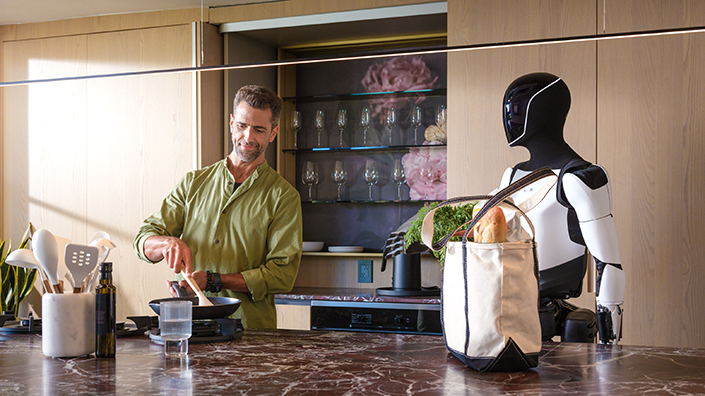
Tesla's Optimus robot is intended to perform 'unsafe, repetitive or boring tasks' (Credit: Courtesy of Tesla Inc)
In this arena, the rigid plastic and cold metal of most humanoids will likely need replacing with something softer and more homely. Prominent companies including Figure are already introducing soft coverings for humanoids, while researchers such as Katherine Kuchenbecker at the Max Planck Institute in Germany have gone further, developing a soft, warm robot that can hug people, enabling much closer and gentler interactions.
Althoefer, who says he is focused on creating robots that improve people’s lives, has his own ambitions for creating a humanoid entirely from soft materials, inspired by Baymax from Disney’s film Big Hero 6. “That is the ultimate soft, interactive, cuddly, non-threatening robotic system.”
Less interesting for the head of Queen Mary’s Centre for Advanced Robotics are the potential military applications – but that does not make them any less likely.
The adaptability, flexibility and continual operation of next-generation humanoids will be as well-suited to the battlefield as to the home, allowing them to operate tools, vehicles and weapons without modification. Tech CEOs and generals around the world will undoubtedly already be exploring deployment.
Not yet a match
Anyone sharing concerns about the prospect of fully automated death and destruction will not be comforted by the thought that humanoids are not limited to human measurements or capabilities. If a 6ft robot is concerning, what about a 12ft variant? Or a 3ft version that’s capable of climbing up walls and through windows?
Taller and smaller robots will likely come as the sector diversifies, Keller says. For now, he believes the core focus remains on matching human capabilities in regular tasks – and he has good news for anyone who is worried about where the industry might go. “Right now, no technology can match human capabilities,” he says. “We have far higher energy density that we can bring to the table. We have different ways to activate our body. We have a higher degree of flexibility.”
How long this will remain the case will be determined by engineers – and whether we ought to worry about that will come down to those at the top.
Want the best engineering stories delivered straight to your inbox? The Professional Engineering newsletter gives you vital updates on the most cutting-edge engineering and exciting new job opportunities. To sign up, click here.
Content published by Professional Engineering does not necessarily represent the views of the Institution of Mechanical Engineers.