While contemplating the decades ahead, she also feels a tinge of sadness that she’s not just starting her career, facing the “incredible” challenge of “bringing machines together in ways we haven’t seen before”.
With the explosion of generative artificial intelligence (AI), along with engineering entering a new, multidisciplinary phase, Meese believes this generation has the opportunity to redesign and reinvent the way robots help older adults live more independently, while relieving some of the pressure building up in the UK’s healthcare service.
When the professor’s thoughts settle back into the present, she is concerned with balancing the immense benefits of assistive robotics against the very real risks surrounding privacy, security and over-reliance on technology.
“There is an urgent need for comprehensive and adaptive regulations that balance innovation with user protection,” states a recent IMechE report, Automating the Home, for which Meese is the lead author.
The report delivers nine firm recommendations, but perhaps the most critical one is also the simplest: “Focus on patient-centred care”. In other words, design solutions for the people who need them – not for the sci-fi spectacle, but for the human.
Preventing a fall
Most experts working in healthcare robotics didn’t need Lord Darzi to tell them the NHS was struggling. But in November 2024, he released a report concluding that “the NHS is in critical condition”, albeit with strong vital signs.
The report explored everything from cancer treatment to GP visits, but caring for the elderly has always been an important piece of the puzzle. Falls and fractures account for more than 4 million bed days a year, costing the NHS some £2bn. According to the NHS, 30% of people aged 65 and above will fall at least once a year, rising to half of people aged 80 and above.
To make matters worse, says Meese, the UK, like many other countries, has a rapidly aging population, with older adults developing multiple long-term health conditions. This puts further strain on the NHS, which itself is aging as it treats more than a million patients each day.

Professor Helen Meese
To address this, the NHS is leaning into robotics. The health service has an AI lab and, earlier this year, rolled out an AI tool designed to prevent up to 2,000 falls and hospital admissions each day.
The tool, an app that can predict falls with a claimed accuracy of 97%, is being used in more than 2 million patient home care visits a month. It checks things like blood pressure, heart rate and temperature, flagging signs of general health deterioration or illness. The NHS says the app is saving £1m a day.
Robotics merged with manufacturing a long time ago, and few people at airports panic now when they see a Star Wars-looking droid cleaning the floor autonomously. Self-driving cars are advancing and, although you may not see them, porter robots are quietly moving through some hospitals, relieving nursing staff from having to deliver medical samples or dirty bed linen. Because hospitals are unpredictable, such robots typically use back corridors and elevators.
Automated assistants
Google “Tombot labrador” and you’ll meet an astonishingly realistic robotic dog, which can help older people manage stress, anxiety or loneliness. Non-human companions – such as robotic toy seals – have proven successful in therapeutic settings, with research ongoing into their ability to support dementia patients. For the elderly, knowing that the worst thing that can happen to your companion is a flat battery takes away the stress of owning a “pet”. Meanwhile, Intuition Robotics’ “chatty” ElliQ robot (a tabletop device) is already using AI to help combat loneliness and isolation.
A few more clicks and you’ll find Chinese company Unitree, which will sell you a humanoid robot for under £6,000. Universities around the world are exploring what robots are capable of and how they can be used as “team mates” around the home or at care facilities. Meese points to projects like JuBot, or the work of the Fraunhofer Institute as examples of “clever and interesting” research in assistive robotics, with a strong focus on physiotherapy and helping the elderly stay mobile.
“Technology can absolutely help bring the NHS out of the trauma ward,” says Meese, returning to Lord Darzi’s report. “But we must have guard rails in place.”
AI changes the game
Dr Ronnie Smith, a senior engineer at The National Robotarium, agrees – although he’d say we need to think carefully about how to “match care needs with robotic capability”.
Smith is an expert in assisted robotics for older adults, which was the subject of his PhD studies. He says the arrival of generative AI and large language models has changed assistive robotics in two key ways: it’s given them perceptual powers like never before, and it’s turbo-charged their ability to communicate.
In the past, teaching a robot to understand its physical environment or enabling it to speak to humans meant creating data sets or language models from scratch. Today’s tech has opened the door to more capable models available “off the shelf”.
This, Smith explains, leads to a tension. To learn, the systems need data, which is often private and sensitive. The more data they have, the better they can help. But the more data they hoover up, the more they intrude into the realms Meese’s report warns us about: privacy and security.
“People, or the end users, must have control over where their data goes,” says Smith. “Technology shouldn’t be forced on people. We need to regulate for the AI we have today, which will set the foundation for robotics in healthcare.”
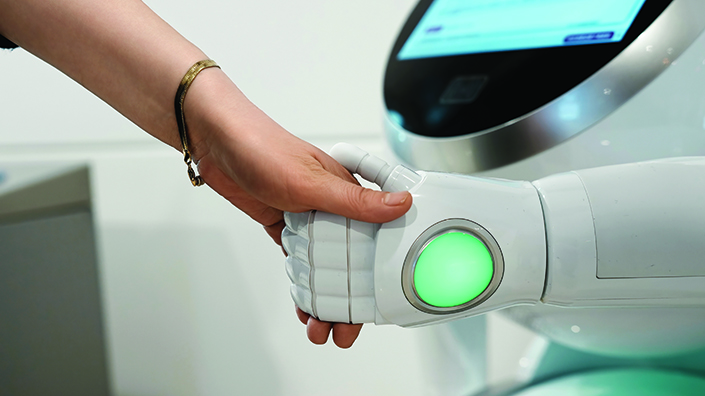
(Credit: Shutterstock)
Helping older adults make decisions about their privacy and digital dignity is important to the “network of care”, a term Smith uses that includes relatives, carers and health services. Managing data, as we do with mobile phones and similar devices, is a pressing issue for where robotics is today, he adds.
Telepresence robots (like ElliQ or the range from Temi) can be incredibly efficient at checking in on patients, relieving human carers from having to travel. They can navigate, gather information through cameras and microphones, and do some basic physical tasks. The catch is how to make these robots as useful as possible without forcing people to surrender their privacy.
Smith has experimented with solutions such as using motion sensors or Wi-Fi signals instead of intrusive cameras. But, he says, this is something engineers will have to wrestle with as robots become more capable. In future, companion humanoid robots could become the “interface for the smart home”, controlling the lights and predicting through powerful data-gathering when a human needs help getting something from the fridge. By that point, assuming robotics will advance to a point where machines are trusted to physically interact with humans, a solid foundation, as Smith puts it, of standards and regulations will be crucial.
“I’m yet to see a realistic, off-the-shelf companion robot I’d want to buy and put into my home,” he says. “We need to understand what the technology is. Regulation should follow standards, which should follow user cases.”
Magic solution or marketing hype?
Rich Walker, a director at Shadow Robot, puts it bluntly: we must protect our brains from being hacked.
The idea of humanoid robots and their capabilities, he says, comes with a lot of hype and not enough understanding at the senior levels of companies investing or developing these technologies.
“I often think we’re automating the wrong problem,” Walker says. “Do we want to stem loneliness by having people talking to people, or by having people talking to fake people? I go with people talking to people.”
Walker, who is also a director at EuRobotics and has helped Innovate UK with policy, is an advocate for approaching a problem from the right angle. “Don’t just say: ‘Let’s start a giant programme to build robots!’ As much as I’d love that, it would be a giant programme to build robots, not how we practically, effectively and efficiently solve a healthcare problem.”
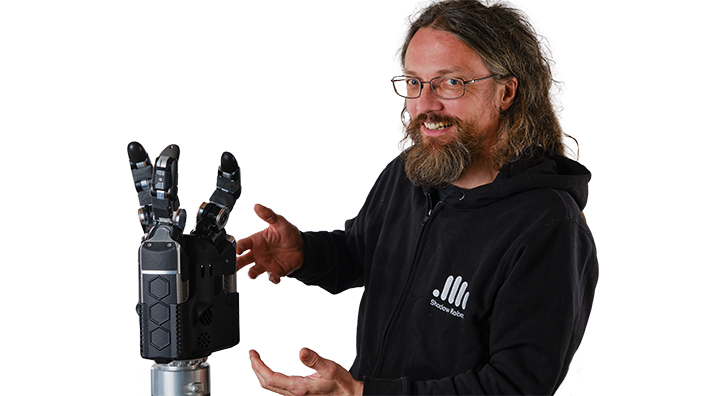
Rich Walker
Sometimes, Walker explains, a simple tabletop dishwasher, which means no bending down for its owner, is the “magic solution” that’s needed to help an elderly person live comfortably at home. “Wearable robots” like exoskeletons, he adds, are not often thought of as robotics, but can help older adults climb stairs or lift objects. He maintains that “often, the problems aren’t where you think they are”. A healthcare worker in Yorkshire may need help to shrink distances they cannot cover without a car, while their colleagues in London can cycle to visit patients.
To those who argue that there aren’t enough healthcare workers, Walker says: “Why do we never have a problem with there not being enough bankers?” His solutions require us to zoom out, to explore salaries and state budgets or ask whether houses are built in a way that supports mobility in later life. “There are unique challenges and systemic problems,” he says. “The system is brittle in parts. There’s sand in the wheels. And just looking at robots misses some of the big issues.”
Rules written in blood
The IMechE report talks about collaboration between policymakers, healthcare professionals and the robotics industry as a key part of creating a robust regulatory framework. A way to see the bigger picture. Or, as Walker puts it: “How do we improve the quality of lives by making sure that the naked forces of capitalism aren’t spamming our planet with things that could kill us accidentally, just because they’d make more money that way?”
For inspiration, Walker points to the UK’s MOT system of checking whether vehicles are roadworthy every year they are on the roads. Getting this right takes building a regulatory system, a culture and a process, he explains. And, of course, a clear understanding of which standards must be achieved for a vehicle to pass its MOT test.
Whether we are dealing with catastrophic mechanical failure on motorways or robots in people’s homes, Walker says that we should follow the approach of the railway industry, where accidents lead to iron-clad rules to avoid future accidents – we don’t want the rulebook to be “written in blood”.
“Engineers are taught about ethical and responsible design,” he says. “They create tests that are useful, sensible and regulatable.”
Engineers carry the ethical torch
While today’s risks may relate more to data and privacy, ethical decision-making is a thread that runs through the report’s recommendations.
“When you develop this technology,” says Smith. “Know what it will be used for. Focus on driving down the costs and create robots that solve specific problems in the home. Design with privacy in mind. To maximise acceptance, care robots should be provided as a tool under the control of the user, not forced on them.”
Meese agrees, urging transparency, more research and vigilant oversight. “I’m passionate about making sure we have access to this technology,” she says. “But I’m also very aware of the risks. We have to mitigate as much as we can. That’s why we have standards and regulations. Engineers must work to these standards and regulations.”
She says companies like Boston Dynamics have cracked a lot of the mechanical engineering in robotics, but there is plenty of work ahead. Hardware, software, electrical and biomechanical aspects are starting to combine in systems engineering, opening up exciting new career paths. And then there’s the challenge of releasing robots into “chaotic”, unpredictable environments such as homes or hospitals.
“The next 20 years is going to be incredible,” Meese says, her thoughts racing into the future again. “But we carry the responsibility to make sure that anything we do is for the patient.”
Safe as houses
IMechE’s Automating the Home report delves deeper into the regulatory framework around robotics in healthcare. Its lead author, Professor Helen Meese, worked closely with her research partners – the Universities of Sheffield, Sheffield Hallam, Loughborough and Nottingham Trent – for six months before publishing her findings. The following are the reports’ key recommendations:
1. Establish comprehensive safety standards
Create detailed safety rules made especially for robots in home and care settings. Make sure there are laws or regulations that enforce these rules, and that standards are kept up to date.
2. Promote ethics and transparent use
Make sure robots are used fairly and openly: people should know how their data is used, give consent, not become too dependent on these machines and not be misled.
3. Focus on patient-centred care
Tailor robots to different needs (physical ability, language, preferences) and get feedback from patients about whether the robots are providing comfort, dignity and safety.
4. Enhance cybersecurity and data protection
Make sure robots are built and operated with strong protections for data (how it’s collected, stored, shared) and for privacy.
5. Support research and development
Allocate more money and effort into developing these assistive and social robots. Incentives (like grants), partnerships between public organisations and private firms, and focus on solving current challenges (cost, human-robot interaction, scale) will accelerate progress.
6. Implement training and education programmes
Equip both healthcare workers and the public with understanding about what robots can and can’t do, how to use them safely and effectively, and what risks exist.
7. Ensure interoperability and integration
Make sure robots can work smoothly with existing systems (other home devices, healthcare records, etc). Use common standards so robots don’t become isolated tech islands, but instead fit into the broader care ecosystem.
8. Monitor and evaluate impact
Collect feedback from users and staff, use data to adjust designs and deployment, and require testing across different real-world settings.
9. Regulatory compliance and oversight
Make sure robots comply with international standards, subject them to certification and testing before they enter homes or care settings, and give oversight bodies real teeth.
Want the best engineering stories delivered straight to your inbox? The Professional Engineering newsletter gives you vital updates on the most cutting-edge engineering and exciting new job opportunities. To sign up, click here.
Content published by Professional Engineering does not necessarily represent the views of the Institution of Mechanical Engineers.