The VX4 lifted off in helicopter mode, transitioned into wing-borne flight, then changed back again before landing. Its makers claimed
it was the first public eVTOL flight of its kind at the show. The flight was some vindication for a technology often viewed as being just around
the corner but never quite here –
yet it really proved only that a small test can work.
If eVTOLs are going to carry passengers rather than just wow crowds at airshows, they need somewhere to take off and land – and that poses its own set of problems, including how to fit an all-new type
of aviation infrastructure into cities that are already very crowded, both above and below ground.
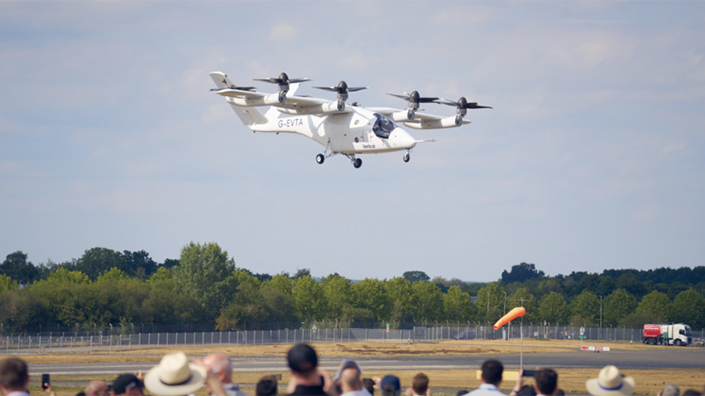
The VX4 flight at Farnborough International Airshow (Credit: Vertical Aerospace)
The industry calls eVTOL take-off and landing positions vertiports.
They blend aspects of an airport,
a high-powered electric charging
hub and a small fire station – all in
a place where real estate is at its
most expensive and with plenty
of hurdles to overcome.
“There’s really great progress
and development happening with eVTOLs, which will enable a lot
more vertical flight transportation
in major markets and major cities around the world,” says Addison Ferrell, director at Skyports Infrastructure, a vertiports and heliports provider. “However, there’s not sufficient infrastructure to make that whole ecosystem actually work.”
Permission to land
If eVTOLs are to truly take off in the public imagination, they need to be located near where people want to travel. That comes with its own challenges as operators try to squeeze infrastructure into already crowded city centres and tack them on to existing transport hubs.
Ferrell says Skyports starts with demand, then overlays a series of technical constraints. The aircraft needs safe airspace to enter and leave the site. It can’t interfere with
an existing airport approach, and the immediate surroundings matter too.
Vertical take-off is also a little bit of a misnomer – an aircraft doesn’t just cruise above a landing pad before dropping straight on to it.
“They come in on the glide slope,” says Ferrell. That makes
for a smoother landing for passengers, but a headache for planners. “You
can’t have a building immediately adjacent to the landing pad that’s blocking that approach.”

Addison Ferrell, director at Skyports Infrastructure
As well as needing space for the aircraft to land, operators have to move passengers safely,
fit charging equipment and keep people away from areas exposed to downwash. Load-bearing calculations are also key because, while the craft are not extraordinarily heavy by city standards, that weight arrives in a different way.
Ferrell says many eVTOLs are expected to have maximum take-off weights below 3,175kg, while a facility intended to accept larger helicopters could need to cope with aircraft weighing perhaps 6,800kg or more. But any hard landing can put a large dynamic load through a relatively small part of the structure. And few building inhabitants would want to take the risk of their ceiling caving in courtesy of a rougher-than-expected landing. Ferrell says lower-cost
real estate, such as warehouses
or exhibition halls with long spans between columns, is also unlikely
to make for a good landing spot. While it might provide large empty roofs, there isn’t much capacity
for concentrated loads.
Multi-storey car parks have more potential. They are already designed to support large numbers of vehicles, have regular structural grids and offer potential paths to run new electrical services skywards. Skyports is putting one of its planned facilities on top of
a nine-storey car park at Dubai Mall. “It’s easier to build from new at grade,” says Ferrell, than it is to retrofit an existing building.
All of which explains why
the first wave of eVTOL operations may actually end up closer to past generations of skyborne tech than you might think. Rex Alexander, infrastructure adviser to the Vertical Flight Society, expects many early services to start at existing airports rather than newly built city vertiports.
Airports already have protected airspace, aviation safety systems, passenger infrastructure and a
better chance than most of securing large new electricity connections. Traditional heliports are less likely
to be able to provide all those things. “We’ve never designed a port for
high throughput,” says Alexander.
The UK Civil Aviation Authority (CAA) has made much the same assumption, saying it expects
initial eVTOL flights to use existing aerodromes while it develops bespoke rules for vertiports specifically. It currently hopes
to have the regulatory framework
and operational systems required for initial commercial passenger eVTOL flights in place by the end of 2028.
Charging up
The only way that electric aircraft
can be economical is by spending
as much time as possible flying, rather than sitting on a pad filling their batteries. Ferrell says that requires each stand to have charging power
of around 500kW. “Step one is just making sure the amount of power can be delivered to site,” he says. “In order to turn these aircraft quickly, you need a lot of power to go in during
the recharge cycle so that it doesn’t sit there and charge for hours on end.”
Such a huge power demand changes which buildings are viable
to house vertiports. While a high-rise block may have a perfect roof, it might not be able to access the electrical capacity it needs from the grid, never mind routing it safely to the top floor of the building. “Most builders are not provisioning spare 500kW that they’re not going to be using,” says Ferrell.
On a car park or greenfield site, engineers have more options as
they can include new substations, switchgear, transformers, cabinets and heavy-duty cabling in their
initial proposals for a project. But broader constraints, including the overwhelming demand on the grid
for new connections brought about by data centres, means any grid connection can still become one
of the longest-lead items needed
for a vertiport to become reality.
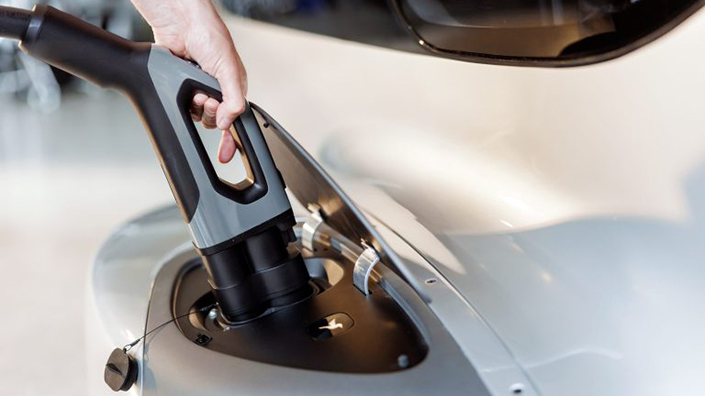
How Vertical Aerospace charging could look (Credit: Vertical Aerospace)
Alexander recalls conversations while working on infrastructure for Uber’s air taxi trial in which charging specialists were discussing 500kW
to 600kW as a likely range for fast aircraft charging. The charger itself is only the visible part of the problem, he says. Further upstream, the electricity network could need extra oomph in the form of a new substation to cope with additional demand – something that can involve even more years
of permitting, construction and equipment procurement.
All that charging also creates
a lot of heat – so much so that Skyports’ system requires offboard active cooling during fast charging.
“You literally are pumping coolant
in and out of the aircraft that’s cooling the battery while it is charging,” explains Ferrell.
Downtown downwash
One of the big promises of eVTOLs has been that electric propulsion should make them considerably quieter than helicopters.
Ferrell says demonstrations he
has attended have shown “a completely different paradigm of noise” compared with conventional rotorcraft. But there’s a wrinkle to
that claim. It’s a different kind of noise, not no noise.
Alexander points to past complaints around delivery drones
as a warning. These have a similar sound to other eVTOLs and the high-pitched whinny has previously exercised the general public when
it happens all day long.
eVTOLs aren’t exactly out
of sight, out of mind either –
at peak, they could be zipping across the skies in highly populated areas. And given it’s a mode of transport that
may depend on public acceptance, every little annoyance matters.
However, some of those hitches can be overcome comparatively easily. At the Downtown Skyport heliport in Lower Manhattan, which Skyports operates, Ferrell says routes for sightseeing helicopters are kept over water and operations are restricted to certain hours. The same could happen for eVTOL services.
A thornier problem is downwash. Every rotor or propeller generating
lift accelerates air downwards. But when that air hits a landing surface
it spreads outwards, creating outwash that can lift loose objects, buffet people and interfere with nearby aircraft.
Alexander says research suggests some eVTOL configurations could produce higher local air velocities than a helicopter of similar weight because their lift is distributed
across several smaller rotors.
Wind warnings
The US Federal Aviation Administration (FAA) has started turning that concern into design guidance for vertiports.
Its current engineering brief
warns that air velocities of about 34.5mph (55.5km/h) or
more can affect safety, calling for downwash caution areas wherever those speeds could
be reached.
The eVTOL-enabled airflow can cause ground erosion and create wind hazards that are dangerous
for both people and equipment.
“We’ve always had downwash,” says Alexander. “The question is, what’s it look like under the approach path, under the departure path?
How far does the outwash manifest beyond the landing area? And then how do I design my infrastructure from an engineering standpoint to account for that?”
For now, Alexander says, parts
of the problem remain “kind of a
blank slate”.
Safety first
The other major difference between
a heliport and a vertiport that needs to be engineered is what happens when something goes wrong.
Conventional fire protection in aviation is designed around liquid hydrocarbon fuels. But the lithium-ion batteries likely to power the first generations of eVTOLs fail in a different way. The batteries, if damaged, can enter thermal runaway, producing enough heat to trigger neighbouring cells and cause the battery to explode.
“Foam won’t do anything for that,” says Alexander. “It’s all about water and it’s not about putting out a fire;
it’s about containing the fire.”
Skyports has had to design for
both worlds because some of its facilities will serve helicopters as
well as eVTOLs. Its vertiport beside Dubai International Airport reached technical completion in April. Ferrell says its deck-integrated firefighting system can spray suppressant upwards from the landing surface, supported by pumps and tanks.

Rex Alexander, infrastructure adviser to the Vertical Flight Society
“It does require extra thinking, a lot of work with the regulator to make sure that they are understanding or OK with it, and some pretty highly engineered equipment,” he says.
Engineers can borrow lessons
from the rapidly developing fire
codes covering the operation
of electric cars and the parking structures that house them, but an aircraft battery presents a different problem because of its scale.
The rules in this area are still catching up. The UK CAA has established a Vertiport Stakeholder Working Group, whose job is to examine the physical design, obstacle limitation surfaces, visual aids, and rescue and firefighting requirements of vertiports. In the US, meanwhile, the FAA’s vertiport engineering guidance remains a supplement
to its existing heliport standards.
Alexander has seen the consequences in the US, where one standard can incorporate another
by reference. “When you’re looking
at building out any infrastructure in this space,” he says, one of the first questions should be: “What are the codes and standards?”
Slow and steady
Beyond the minutiae of regulation, codes and standards, there’s a much bigger problem: knowing how many vertiports to build in the first place.
Spending millions building bespoke vertiports today is a risky bet if the economics don’t work well enough to make the idea an attractive alternative for passengers. As a result, Alexander expects the industry to prove itself by piggybacking on infrastructure that already exists, particularly at airports, before investors put big money into large networks of new sites.
“How do you prove the concept?” he says. “Yes, it’s a viable concept. Yes, it works. Yes, it’s a transportation model. OK, I’m interested. Now I’m going to invest.”
If that happens, the flying taxi’s arrival is likely to be more gradual
than the industry’s more breathless predictions suggest. The first services could link airports and
other existing aviation sites before spreading towards the city-centre rooftops and car parks that could make eVTOLs genuinely useful as
a new form of transport.
And usefulness matters. A vertiport 40km outside a city might be cheap and straightforward to engineer, Ferrell points out, but it solves very little if passengers then spend another hour travelling to where
they actually wanted to go.
The trick will be engineering sites that satisfy all those competing demands without making each journey prohibitively expensive.
“A lot can be overcome by just throwing money at a problem,” says Ferrell. “But, ultimately, what we’re looking to do is be part of a service that is affordable and accessible.”
Want the best engineering stories delivered straight to your inbox? The Professional Engineering newsletter gives you vital updates on the most cutting-edge engineering and exciting new job opportunities. To sign up, click here.
Content published by Professional Engineering does not necessarily represent the views of the Institution of Mechanical Engineers.