The 230001 is remarkable for much more than being the graduate engineer’s regular workspace, however. The GWR train has been modified to run on onboard batteries – and in August this year, it broke the world record for the longest distance travelled on a single charge.
Verified by the Railway Performance Society, the converted former Underground train travelled 200.5 miles (322.7km) between Reading, Paddington, Oxford and back again on the night of 19-20 August, smashing the previous record of 139 miles (224km) set by Stadler Deutschland in Berlin in 2021.
The world-beating run was the fruition of three years of work for Prince, a student affiliate member of IMechE since 2020. GWR hopes it could shape the future of regional train travel in the UK, by showing that battery trains can provide a viable and cost-effective alternative to diesel.
Making contact
The journey began at rolling stock manufacturer Vivarail, where Prince worked during his university placement year. When the company went into administration in November 2022, GWR purchased the project and continued the work.
The record-breaking train is formed of three carriages, with six batteries split between two powered carriages at the front and back. The lithium-ion batteries have a hybrid chemistry selected for its safety and performance, with a thermal management system keeping the cells at a steady 25ºC.
While the batteries are undoubtedly a vital component for a successful battery train, perhaps more important is the train’s rapid charging capabilities. The automated charging system is designed to drop contact shoes down on to an electrified rail when the train is in position at a station, quickly filling the batteries before the shoes retract and the train moves on.
“The only real option was to develop a charging system that was in the four foot between the rails,” GWR engineering director Simon Green tells Professional Engineering. “One of the advantages it has is it allows you to send from the trackside direct to the batteries – so not going through a mains transformer and other components that might limit the current flow.
“Ultimately, the power that you can get through, because it’s quite a beefy contact system… does allow very rapid charging. In fact, it’s theoretically possible to charge at a faster rate than we’ve demonstrated so far, particularly through the shoe.”
He adds: “The train could have been anything – it happens to be a 230 – but perhaps what’s more interesting is the way that the line-side storage has been interfaced into, essentially, the domestic supply. So it’s not coming from the high-voltage network, it’s coming from the low-voltage domestic network, and it kind of shows how this technology could be applied in other areas that are remote from a high-voltage supply.”
SuperMode
The charging system is in focus on 4 November as Prince speaks from the train, with checks ongoing to ensure it is in working order. The graduate engineer has spent much of the last two years doing hands-on testing, identifying faults during research and development, helping run tests with the drivers and guards – and, ultimately, moving the technology from R&D towards passenger services.
While the Greenford branch line is only 2.5 miles (4km) long, the team needed to move the battery train further during its development, including 72 miles (116km) when it was delivered to the Reading depot under its own power. A new UK record of 87 miles (140km) was set following an increased focus on energy consumption and range, at which point the total range was predicted to be 120 miles (193km).
From there, the world record started to look achievable – and the final push to 200 miles came when the team spotted the perfect opportunity to coincide with Railway 200, celebrating the 200th anniversary of the birth of the modern railway.
Engineers had to “eke out” as much as possible from the batteries to make that possible, Prince says. One of his roles was making sure they had enough energy during runs.
“Whenever we’ve been taking it longer distances, I’ve been in charge of whether it’s got sufficient range or whether we need to turn around and go back,” he says. “We found that some styles of driving were much more efficient than others.”
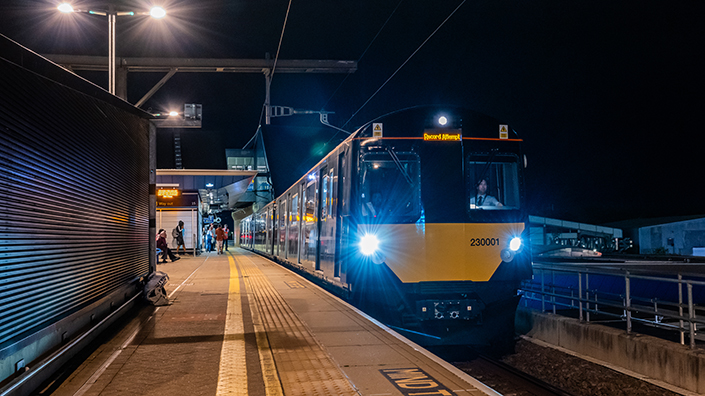
The train on its record-breaking run
Perhaps surprisingly, this did not involve accelerating and decelerating as gently as possible. “It’s interesting, it’s the exact opposite. It’s very counterintuitive,” Prince says.
“Ultimately, the most efficient way to drive this train is to accelerate as fast as possible, with maximum power until you reach your target speed, and then to shut off completely and let it coast down to your lower range. Then apply maximum power, accelerate back up.”
The team cut out as many stops and starts as possible to extend the range, which also involved reducing the top speed from 60mph (97km/h) to 40mph (64km/h) to reduce air resistance – although that is still faster than it would normally run on the Greenford branch, Prince points out.
The engineers also introduced the SuperMode operating style to maximise efficiency, which involved going beyond the normal battery range of 85-10% charge. “Because there are a lot of engineers on board monitoring it closely, we could then run the batteries much, much lower than they would do in normal operation,” Prince says. They went one step further by using one battery at a time for most of the record-breaking trip, swapping to the next one when each ran out.
Threading the needle
After years of dedicated work, the project culminated with the record attempt on the night of 19 August. A tense Mission Control-style atmosphere pervaded the cabin as the 230001 left Reading, Prince says.
The graduate engineer worked throughout the night with about 10 colleagues, managing the range and checking if it was ahead of or behind predictions. Another role involved making sure systems stayed within normal parameters, while another mapped other live trains on the network.
“We were trying to avoid having to stop,” Prince says. “We were monitoring the other traffic to thread the needle between the other trains that were running – that was probably the bit that meant we could go so far.”
The team’s diligent approach paid off as they passed the former world record distance – and 60 miles later, they made it back to a large reception at Reading depot, shortly after 6am on 20 August.
“It was very exciting. We were quite tired by that point because we’d been up for over 24 hours,” Prince says. “We were quite confident in this train. But all the other trains around, if any of them had gone wrong, then it would have impacted us as well. So it was very good that it all came together in the end and we pulled it off.”
‘Islands of electrification’
The record “demonstrates the viability of battery train technology in wider application”, Green says, and could be a significant step towards public services. A GWR fleet of battery trains would rely on “islands of electrification” on routes such as the Devon and Cornwall branch lines, allowing trains to charge from overhead lines while avoiding expensive installations in areas with challenging topography.
Public services will not have the luxury of avoiding stops and using a sawtooth-like speed profile, however, so the team will have to take the relevant lessons from the project and apply them to a different way of operating.
“Turning the heating off, turning all the lights and so on off is not something you would realistically do during passenger service,” Prince says. “But the message was ‘If 200 miles is feasible when you push the train, then we shouldn't be worrying about something in the range of 50-100 miles’… [which is] longer than the 10 or 20 miles that people might have been thinking were possible in the past.”
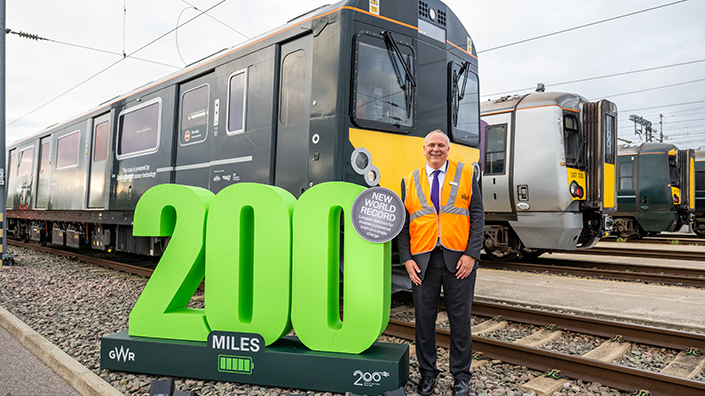
GWR engineering director Simon Green
For Green, public services will also have to avoid any compromises on top speed. “If we introduce a battery-electric train, we want it to deliver the same timetable,” he says. That will limit the practical range – “they drove [the world record attempt] like somebody driving an electric car with extreme range anxiety,” Green says – but as battery technology gets better, they expect to get 60-80 miles out of a train being driven normally, depending on gradient and passenger loading.
“It’s likely to be driven in a way that’s much more similar to a diesel train today,” he says. “We would expect it to have better acceleration characteristics, though.”
The record was the “culmination of a lot of hard work”, he continues. “I often say I’d quite like somebody else to go out and break it as well… because I think that allows the technology to develop.”
GWR is working with Network Rail to identify areas for electrification, and will be developing proposals for both infrastructure and train fleet procurement in the next one to two years as it plans the replacement of its diesel fleets.
Networking opportunities
Despite having an electrical engineering background, Prince says the IMechE Railway Division has provided “a lot” of support. The institution’s Future of Rail competition gave him the confidence he needed for presentations and introduced him to senior colleagues, while the Technical Tour gave him opportunities to network with the “very, very strong” community in the division.
“It has been a really useful way of meeting and networking with other people,” he says. “The rail division within IMechE has been incredibly useful.”
Want the best engineering stories delivered straight to your inbox? The Professional Engineering newsletter gives you vital updates on the most cutting-edge engineering and exciting new job opportunities. To sign up, click here.
Content published by Professional Engineering does not necessarily represent the views of the Institution of Mechanical Engineers.