Engineering news
A new eggshell-inspired material, developed by researchers at Dalian University of Technology in China, could provide a potential solution by offering new spacecraft protection.
It might seem counterintuitive to use fragile eggshells as a blueprint for strength, but the team found that organising water-filled aluminium eggshells into an array provides useful material properties, particularly when they are positioned blunt-side down between two aluminium impact plates.
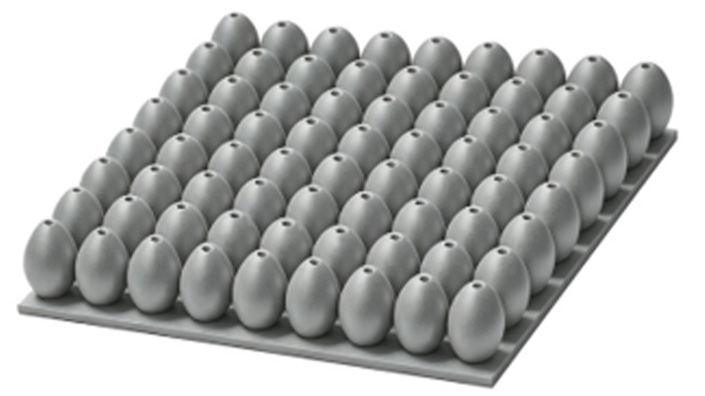
An artist's illustration of a water-filled aluminium eggshell array (Credit: Wang et al)
“Natural biological structures have evolved to demonstrate excellent energy absorption performance over long-term adaptation,” said Yuxin Wang, author of the new research in the Journal of Applied Physics.
Rather than being concentrated within a single eggshell, the energy from an impact gradually dissipates through the material, allowing each shell to sequentially collapse and deform.
“A single eggshell breaks easily under local force, but the protection mechanism of the eggshell array is completely different,” Wang said. “The cooperative deformation of these eggshell units transforms the local impact load into distributed energy dissipation across the metastructure, thereby significantly enhancing the anti-impact performance of the target plates.”
Filling the eggs with water also helps. Under intense impact, the water sloshes around and suppresses impact waves from being propagated. This interaction between the water and the aluminium eggshell reportedly reduces and dissipates the energy significantly.
Several 3D prints and simulations were compared: aluminium plates alone, water-filled aluminium spheres sandwiched between aluminium plates and just the eggshell structures.
The sandwiched, water-filled eggshell material performed best. It withstood high loads and reduced the velocity of an impact projectile by nearly 65%, compared with only a 51% reduction achieved by the aluminium plates on their own. Among the various possible eggshell orientations, metastructure patterns with the eggs placed upright and their small end contacting the top plate were the most effective.
Before being used for lightweight shielding on spacecraft, the team said the material’s geometry and filling would need to be further optimised and impact-tested. The researchers are refining the thickness of the aluminium eggshells, their aspect ratio and their layout to improve the material’s protective energy absorption.
“This work demonstrates that bionic, lightweight metastructures are a promising route for hypervelocity-impact protection,” Wang said. “We hope this research can attract more attention to bio-inspired protective structures.”
Want the best engineering stories delivered straight to your inbox? The Professional Engineering newsletter gives you vital updates on the most cutting-edge engineering and exciting new job opportunities. To sign up, click here.
Content published by Professional Engineering does not necessarily represent the views of the Institution of Mechanical Engineers.