Engineering news
The unmanned X-37B Orbital Test Vehicle mission 4 (OTV-4) landed in Florida yesterday (May 7) after taking off on 20 May 2015. Speculation about the goal of the re-usable OTV-4 and its three predecessors has existed since their first flight in 2010, with official details leaving many questions remaining. During its orbit, the craft tested an experimental propulsion system and exposed a selection of 100 different material samples to the space environment to study their response, but it has long been thought that the OTVs could also be used for surveillance.
Tim Robinson, editor in chief of Aerospace, the Royal Aeronautical Society’s magazine, said one of the most interesting features of OTV-4 is its high manoeuvrability compared to satellites. The spacecraft’s low orbits were not made officially public and a network of enthusiasts was needed to track the vehicle, which went missing from its spotters twice during its recent mission. “If you have satellites you have predictable orbits and people know when to hide their most secret stuff and push classified aircraft back into hangars. With this… you can change orbits and keep people guessing as to where it is going to turn up or at least maybe give them shorter notice.”
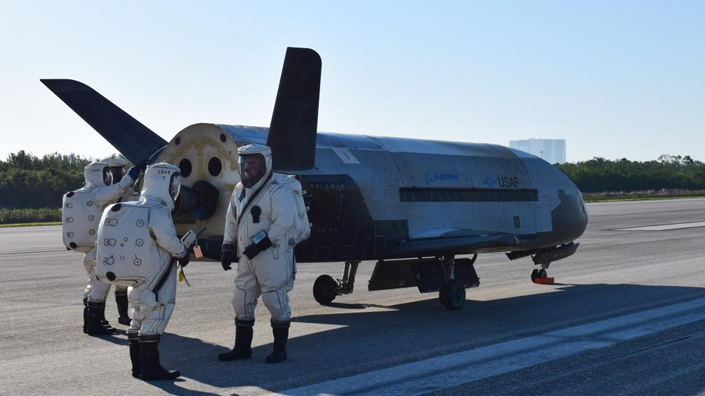
The X-37B Orbital Test Vehicle-4 lands at Kennedy Space Center (Credit: U.S. Air Force)
Space historian David Baker, who worked at Nasa during the Gemini and Apollo programmes and edits Spaceflight magazine from the British Interplanetary Society, said the vehicle is “designed to be covert” allowing it to avoid being tracked. This would allow it to deploy “sleeper satellites”, he claimed, small units of equipment which could be camouflaged within space debris fields and hidden from other countries’ surveillance, on standby for use in the result of an attack on military and communication satellites.
"A James Bond environment"
“You no longer need to have a single physical structure which one would identify as a satellite,” he said. “You could have components of a satellite ranging in virtual proximity so you can remake the [communications] capability from very tiny modules, electronic modules, and devices and power generation systems, which are dispersed among debris.”
Although Baker acknowledges the network of ghost satellites sounds straight from a “James Bond environment”, he said recent air force literature has discussed the need to “diversify the type of payloads” being put into orbit as the prospect of anti-satellite attacks during conflict becomes more of a possibility. The need for back-up modes of satellite communication has been discussed since the 1960s, he added, when high altitude nuclear tests created electro-magnetic pulses which destroyed several satellites.
Other prominent theories surrounding the X-37B programme include the possibility of surveillance of ground targets or foreign satellites. Earlier rumours of the OTVs being secretive space bombers were previously dismissed by experts.
The Air Force is preparing to launch the fifth mission from Cape Canaveral Air Force Station, Florida, later in 2017.