Many people have a fascination with family trees, scouring archives and sending samples off for DNA analysis all with the goal of understanding where they came from and what made them the way they are. Engineers and machines have their family trees too; engineers are trained by older engineers and they, in turn, by the generation before them. Machines are made by machines made in turn by older machines. It would be wonderful if we could trace our engineering genealogy, following the lineage back and discovering that some part of our technical knowledge was handed down from Barnes Wallis or Robert Stephenson.
As for machines, almost every mechanical engineering product on earth is descended from Black Country workshops and from tools made by Whitworth or Bramah. Engineers should take the time to learn about the history of their discipline, it is only by studying the past that you can understand the present day. Luckily a large part of our industrial heritage has been preserved and there are many sites where engineers can see their history in action.
One of the roles of the Institution is to celebrate this industrial past, to acknowledge the good work being done and to use the national interest in heritage to raise the profile of engineers and engineering amongst the general public.
To this end, the Institution’s Heritage Committee has presented Engineering Heritage Awards (EHA) to the following sites and artefacts in 2018:
George Dowty Internal Sprung Wheel
Patented by George Dowty in 1929 and first used on the Kawasaki KDA5 in 1931. From this initial order Dowty was able to establish and expand the Dowty Group. His legacy continues to this day with Safran Landing Systems, a world leader in aircraft landing gear.
Had George Dowty only invented a new type of aircraft wheel he would just have been a footnote in the history of aircraft. However around this invention he built a company that has been at the forefront of landing gear technology for 75 years, providing employment for the local community and safety critical products for commercial and military aircraft.
Worth Mackenzie Triple Expansion Engine
Built in Stockton-on-Tees in 1895, this engine supplied the City of Hereford with water from the River Wye for over fifty years. Capable of pumping 4.5 million litres of water a day, it is the oldest working engine of its type in Great Britain.
Drinking water is a fundamental human need, so fundamental that we take the technology that delivers it for granted. This late Victorian inverted vertical triple expansion pumping engine represents the final flowering of large reciprocating steam engines, used for pumping stations and marine propulsion. Many pumping engines survive because they were kept ready for emergency use in case their electric or diesel replacements failed.
de Havilland DH.98 Mosquito
Designed and built at Salisbury Hall in 1940, W4050 was the first prototype of the DH.98 Mosquito. Twin Merlin engines and a lightweight structure of Spruce, Balsa and Birch Plywood gave superlative performance. The Mosquito pioneered bonded composite aircraft construction which is still in use today.
It is all too easy to see engineering history as separate silos and to miss the connections between the different strands. The previous owner of Salisbury Hall was Sir Nigel Gresley, the Chief Mechanical Engineer of the London and North-Eastern Railway (LNER) and creator of Flying Scotsman and Mallard. Most British aircraft of the Second World War have a foreign equivalent, the FW 190 was comparable to the Spitfire, the B-29 was comparable to the Lancaster. However no other country had an aircraft like the Mosquito, it stood alone in its combination of speed, range and payload.
Royal Aircraft Factory SE5a
The SE5a fighter played a pivotal role in securing the skies over the Western Front during the First World War. The Shuttleworth Collection’s F904 was built in 1918 and served with 84 Squadron. It is the only original airworthy example in the UK.
Arguably the best British fighter aircraft of the First World War. This particular example served on the Western Front and now 100 years later can still be seen flying. There is a particular importance in an operational artefact, it is only by seeing the piece of engineering in action that it can be fully appreciated, emotionally as well as technically.
Psyche Bend Engine and Pump System
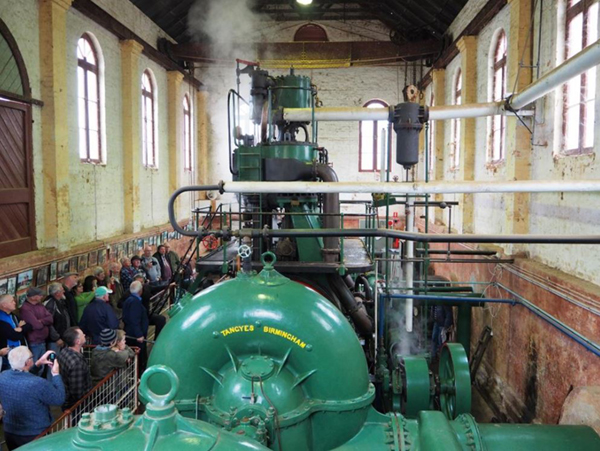
Designed by George Chaffey MIMechE and built by Tangyes of Birmingham, England. Psyche Bend was a key part of the pioneering Mildura irrigation scheme. The 1000 ihp triple expansion steam engine driving four 42” centrifugal pumps was in operation from 1890 to 1959.
Psyche Bend Pumping Station lies on the Murray River in Victoria, Australia and was a key part of the development of the local area. Tangyes remains a famous name in engineering; their hydraulic jacks were used to launch the Great Eastern steamship and to raise Cleopatra’s Needle (one jack remains buried inside the plinth).
Levant Mine Beam Engine
Installed in 1840 by Harvey & Company of Hayle. This double-acting acting condensing rotative steam winding engine operated for 90 years, raising copper and tin ore from 278 fathoms deep. This is the oldest surviving Harvey built engine still running under steam in its original engine house.
Standing on cliffs overlooking the Atlantic Ocean the mine is a reminder of how the Industrial Revolution touched every part of the country. The Levant Beam Engine is believed to be the only Cornish beam engine anywhere in the world that is still in steam at its original mine site and is the oldest surviving beam engine in Cornwall. Built by Harvey and Co. of Hayle and erected in 1840, the 24-inch winding (whim) engine was used to wind skips of ore to the surface until the mine closed in 1930. The predecessor to the Trevithick Society preserved the engine in 1935 and that act of preservation must rank as one of the earliest practical efforts to recognise the importance of the UK Industrial Heritage. The Engine then passed into the ownership of the National Trust who restored it to steam between 1984 and 1992. The engine is steamed daily with steam supplied by a modern oil fired boiler, though a Cornish boiler has been installed in the boiler house as an exhibit.
Tyseley Locomotive Works
A centre of excellence for steam locomotive engineering, Tyseley Depot was built by the Great Western Railway in 1908 and has been in continuous use for the heavy maintenance and repair of locomotives ever since.
Tyseley Shed is an historic location in its own right, a site that was part of the Great Western Railway’s expansion in the first decade of the 20th century. It is also a place where steam locomotives are restored and maintained to main line standard and where a new generation of engineers are trained and employed.
Royal Victoria Hospital Air Conditioning System
Opened in 1903, this hospital was designed around a pioneering ventilation system that fed clean air through a 400 foot long duct to the wards. Temperature and humidity were controlled for the benefit of the hospital patients making this the first public building to be air conditioned.
Air conditioning is another example of an engineering innovation that can be taken for granted, yet it is of great importance for human health and comfort. This pioneering installation also filtered soot from the early 20th century Belfast air.
Barrow Hill Roundhouse
Britain’s only surviving operational railway roundhouse. Built by the North Midland Railway in 1870 it operated continuously until 1991. Restored by Barrow Hill Engine Shed Society in 1998 it forms the centrepiece of a modern rail maintenance facility linking Britain’s industrial heritage with today’s commercial railway.
The historic roundhouse was built to maintain the steam locomotives providing motive power for Derbyshire's coal and iron freight traffic, peaking with a depot allocation of ninety Midland Railway locos in the 1920’s.
In 2018, diesel engined descendants of these locos are serviced and overhauled in workshops surrounding the roundhouse for freight and passenger operators, passing on rail engineering skills to today's apprentices.
Castle Bromwich Assembly Plant
From a World War II Shadow Factory, producing more than 10,000 Spitfires between 1940 - 1945, through nearly 75 years of automotive and industrial enterprise, Jaguar Land Rover’s Castle Bromwich plant remains at the forefront of innovation, technology and high-quality manufacturing producing today's Jaguar cars.
Modern companies continually update their production lines, installing new equipment, improving their processes and bringing new products to market. A surprising number of these operate within heritage buildings, factories with a direct connection to our engineering past.
The Castle Bromwich Assembly Plant was put up in a time of fear in the final years before war broke out. For almost 80 years it has provided jobs for the local community, trained and developed engineers and has produced some of Britain’s most iconic aircraft and automobiles.
Find out more