Engineering news
Levels of radioactive waste production could become “pretty scary” as the world switches to EVs, said Tom Elliott from motor manufacturer Advanced Electric Machines (AEM) at the recent Advanced Engineering industry event (29 October). Acidic gas, sludge and carbon dioxide are other byproducts from extraction of REEs such as neodymium, he added, which are used in the production of permanent magnet motors for cars.
Use of those materials could become increasingly financially and politically unsustainable, he continued, so Tyne and Wear firm AEM plans to provide an alternative. One of its offerings is the new Super Speed Reluctance Motor (SSRD), a demonstrator unit that works without permanent magnets.
While Elliott said the company “needs to work on that branding”, it recently secured a seven-figure contract with an as-yet unpublicised global tier one company to advance the technology for a “high-volume passenger car application”.
Unlike most conventional motors, the SSRD uses aluminium in its coils instead of copper, which can be difficult to source. “We always forefront our conversations about the product on the sustainability scale. But ultimately, in this life, it’s so often cost that really gets you across the line, and we've got a real advantage here,” the global business development director said.
“When it comes to high-volume manufacturing, a lot of the cost in the motor… is in the magnets. And with that removal – in combination, by moving from copper to aluminium windings – we believe we can significantly reduce the costs.”
The motor’s power electronics are different to permanent magnet machines but “roughly cost equivalent”, he added.
The SSRD can run at higher temperatures thanks to the rotor made of steel, he continued. Commonly used N50 neodymium magnets lose their magnetic flux strength as they heat up.
“For our motors, we don’t care,” Elliott said. “We don’t need to worry about excessive cooling of the rotor, oil cooling, et cetera, so we can really push it. We don’t have those compromises so we can run it hotter, and we can also run it at higher speeds.”
Those reach up to 30,000rpm, he continued, limited only by the automotive bearings. “As we increase in speed, we can bring the volume of the motor down, either through a much shorter active length or a reduced diameter, depending on the geometry the customer is interested in,” he said. “Ultimately, what you’re seeing here is that we can dramatically reduce the volume of the machine, and obviously that means a lot less metal, a lot less cost.”
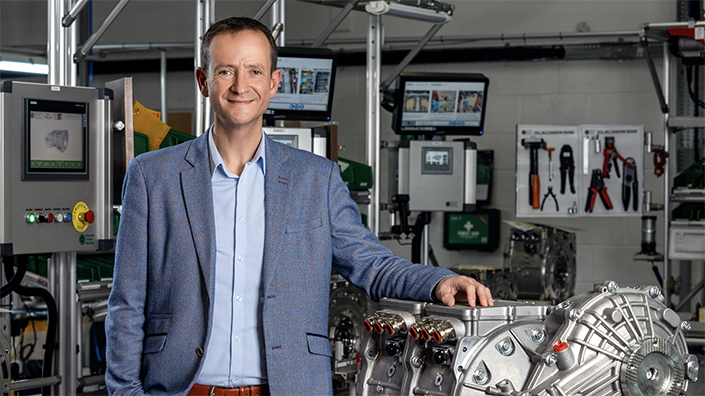
AEM co-founder and CEO Dr James Widmer
By using “abundant materials available from diverse global sources,” according to a recent company announcement, the Newcastle University spin-out also aims to protect manufacturers from disruption and vulnerabilities in highly concentrated supply chains.
“We’re proving that supply chain diversification is achievable today,” said co-founder and CEO Dr James Widmer in the announcement. “This demonstrator shows passenger car manufacturers that they can achieve superior performance while building more resilient and flexible supply chains.”
Want the best engineering stories delivered straight to your inbox? The Professional Engineering newsletter gives you vital updates on the most cutting-edge engineering and exciting new job opportunities. To sign up, click here.
Content published by Professional Engineering does not necessarily represent the views of the Institution of Mechanical Engineers.