At agile robotics pioneer Boston Dynamics in Massachusetts, the Atlas humanoid has learned complex techniques (known as ‘tekkers’ on the pitch) such as the ‘ghost rabona’, involving a deft hook of one leg behind the other to strike the ball with surprising power and precision. Given enough fine-tuning, the technique could one day rival the dazzling strikes of Erik Lamela.
Further from the World Cup action, at Booster Robotics in Beijing, the T1 robot was recently shown kicking a ball with the type of power more commonly associated with a traction engine. The video, entitled Try Stopping This Robot, appears to show the humanoid striking the ball so hard that it damages the wall – something even a prime Roberto Carlos might struggle to do.
The athletic androids are not the first to try the sport, but at first glance the demonstrations appear to be miles ahead of previous robot players. As the countdown to kick-off winds down in the US, Mexico and Canada, we asked experts how the new machines are so on the ball – and if they could ever go all the way, by beating a team of human world champions.
Robots 1-0 Humans
The advanced techniques powering such impressive skills are a far cry from the programming of previous generations of robots, which was done “one joint at a time”, according to Sethu Vijayakumar, director for AI and robotics at the Alan Turing Institute, the UK’s national institute for data science and AI.
While motion planning was optimised based on selected rewards and costs, the technique was extremely compute-heavy and struggled to scale up as the number of joints and the complexity of the task increased, including the number of objects a robot interacted with – a significant number in an 11-aside game of football, for example.
That block was overcome by ‘learning from demonstration’ using expert human demonstrations as the basis for movement, similar to motion capture in filmmaking. That had its own challenges, however.
“When you just retarget it naively on to a robot, it doesn‘t quite work because the human muscles and dynamics are very, very different from robot dynamics,” says Vijayakumar, who is also professor of robotics at the University of Edinburgh and a former judge on BBC’s Robot Wars. “You would have to fine-tune it every time you have a new robot.”
That has changed in recent years thanks to the ready availability of much higher computing power, using advanced new graphics processing units from Nvidia and others. The chips enable physics modelling “in a way that was not scaleable before”, Vijayakumar says, with thousands of simulations running in parallel – the kind of coaching upgrade that could make a San Marino B team look like Brazil’s World Cup starters.
“You could take expert demonstrations, retarget, and then you could do what people call domain randomisation, which means you would run simulations around those desired behaviours… [to] make it robust to different conditions, different surfaces, different kinematics,” he continues.
“The Boston Dynamics example is exactly a reflection of those kinds of dynamic behaviours, where you had a person demonstrate something, then it would be retargeted on to a robot, then reinforcement learning-based methods would use domain randomisation to make this behaviour more robust, and then you get one-shot playback on the real hardware.”
That hardware has been another key area of improvement in recent years. Important additions include brushless motors, which offer higher efficiency and power, and much improved vision systems.
“The standout here is a world-class robot body,” says Chengxu Zhou, associate professor in robotics and AI at University College London. “What distinguishes Boston Dynamics is robustness, getting a clean and repeatable result on real hardware.”
Robots 1-1 Humans
The recent demonstrations seem to have nailed the power and precision required for penalties and free kicks. But Messi and Ronaldo cannot simply rely on set-piece prowess – football is a team game, and even the best strikers of the ball need to apply pressure, link up midfield play and make defensive contributions. If not, the bench beckons.
That versatility of human players means their robot rivals have a lot of improving to do. “We still haven‘t solved the bigger, high-level, long-horizon decision-making,” Vijayakumar says. “If you‘ve got multiple agents in the place, how would you create the right strategy, what are the right decisions to make, in terms of passing the ball, from a long-term goal perspective? That is a layer that sits on top.”
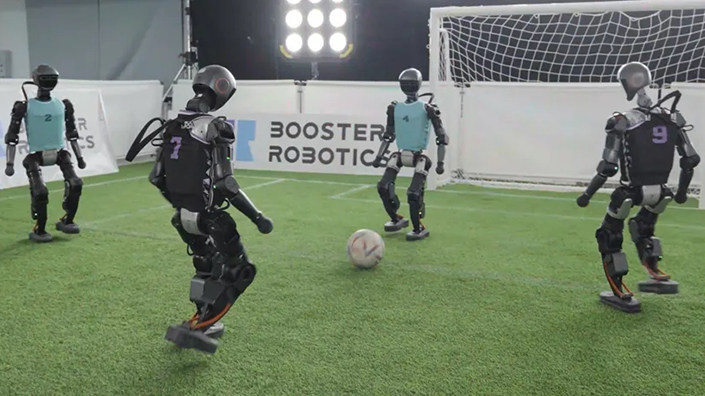
Some Booster robots have a kickabout
That kind of team play is a key focus of RoboCup, an annual competition that pits squads of humanoid players against each other. First held in 1997, the contest has grown in complexity over the last three decades.
The rules have become harder over the years, explains former RoboCup Federation president Daniel Polani – from carpet to artificial grass, from a bright red ball to a standard design, from colourful goal posts to normal white frames.
Involved in the competition since 1998, the professor of AI at the University of Hertfordshire first started with two-dimensional ‘puck’ simulation, followed by 3D simulation, then humanoid simulation. Hertfordshire came second in the competition with its student-developed robot team in 2014.
Booster, developer of the hard-kicking T1, was founded by a former competition participant. “I‘ve seen them in action; it‘s amazing,” Polani says. “They will tackle each other, they will encounter and they will not fall down. They wobble and try everything not to fall down. This is amazing technology.”
Extra time
As they play their first games in the next few days, millions of fans of the English and Scottish teams will be desperately willing them to beat their group rivals and progress towards the final. Could robot teams also become serious competitors in future?
The ambition at RoboCup is for a team of fully autonomous humanoid robots to play and beat the most recent winners of the World Cup by 2050. “When people started looking at humanoid robotics and football in ‘97, that was totally out there,” Polani says. “Nobody had an idea how to do vision properly. Nobody knew how to do humanoids properly.”
Today, however, it is a different story. Robotic systems already have the edge when the game is simplified to a 2D pitch and a puck, Vijayakumar says, similar to an air hockey table: “If you take away the balance, the bipedal locomotion aspects and the dynamics kicking aspect, I would say the speed of sensing, the speed of action, the speed of decision-making is already good enough to potentially beat a human team.”
Those elements are all part of the beautiful game, however. “The complexity of football comes from the fact that you‘ve got whole bodies interacting, tackling, 3D as opposed to 2D, lots of dynamics in terms of spin, curve, if you hit it with the outside of the foot, etc. So there are subtle physical elements that are hard to model, that are still quite hard to capture, even with lots of data.”
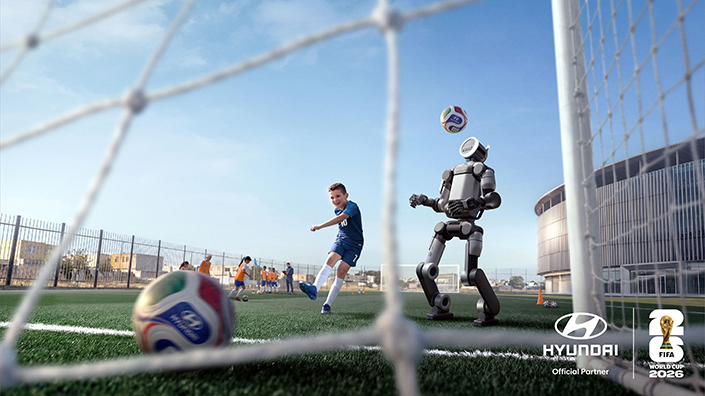
Robustness is another key focus, with tougher limbs and motors needed to survive any Vinnie Jones-style slide tackles. Developers are exploring soft materials and actuation mechanisms to make impact less of an issue.
The kind of dynamic power range demonstrated by a bursting run down the wing is also a big challenge. “Humans are very good at being able to dial up the power output – most of the time they work on low power, then have an impulse, in terms of speed or force,” Vijayakumar says.
Despite the hurdles that remain, he says the 2050 target seems realistic.
Zhou agrees that a robot team will eventually come out on top – but, he says, they will look very different to today’s models. “A single isolated skill – a powerful shot or a save – robots will match before long. A full 11-a-side match is a different order,” he says. “It needs live perception to track a moving ball and 21 other players, split-second tactical decisions, robustness to being tackled and getting back up, and the stamina to do all of it for 90 minutes,” he says.
“Beating an elite human team in a full match is realistically decades away. The long-standing RoboCup goal of doing it by 2050 is optimistic but not absurd, and the machine that finally manages it will be designed for football, not borrowed from a factory floor.”
The final whistle?
While a team of humanoid players might one day outdo even the most clinical and unflinching of today’s players, such as Erling Haaland, most developers will not see the sport as the ultimate application for their machines.
“Many of the same tools we use to train the robot for football transfer to training the robot to do a job in a warehouse or in a factory,” wrote the Boston Dynamics team in a blog post about the recent project, developed in partnership with Hyundai.
The impressive new skills are a demonstration rather than a product, Zhou says. “The transferable part is the training pipeline and the balance underneath it,” he says. “The same whole-body coordination that keeps a robot stable while striking a ball is what it needs to lift and place a heavy, awkward object without toppling.”
The techniques being demonstrated could “absolutely” be useful in other industries, Vijayakumar adds, such as on flexible manufacturing lines. Lifting boxes of different sizes and shapes might require dextrous manipulation and posture adjustments, for example.
For now, with the iconic trophy just weeks from being lifted, the focus can remain on football. “What makes it attractive for us is it‘s a mixture of regulation and freedom,” says Polani. “You control, more or less, the environment – and there are lots of other things that are not so well controlled, like the walking, the behaviour of the opponent, conditions.”
So is the game like a microcosm of the wider world, with rules that need to be followed and unpredictable variables involved as well? “Exactly. It‘s a mixture of things that are fixed and predictable and things that are not.”
The former RoboCup president says he now has people telling him that the 2050 vision is pessimistic. Although he believes it is possible, he “hates” to make time claims as “they are always wrong”.
With the human tournament rapidly approaching, Zhou is finishing work to allow him to watch and Vijayakumar is looking forward to cheering on Scotland. “Football is still a very beautiful game,” he says. “In this world of technology, I think football is a game where a lot of emotions and on-field performances can vary a lot. It may not go to form. So I think that that level of uncertainty is what's really interesting.”
For Polani, while the World Cup will be “fun”, his “heart is always with the robots first, simply because it's my own home territory”. Humanoids are in “a competition against nature or the limits of the possible… it’s momentous. This is not just for this year; it’s for the future.”
Of course, even if a team of humanoids can play and beat a team of human champions, that would not mean the end of the sport as we know it. Fans will remain faithful to their human heroes – even if some glory hunters might switch allegiances.
Think it’s all over? Think again!
Want the best engineering stories delivered straight to your inbox? The Professional Engineering newsletter gives you vital updates on the most cutting-edge engineering and exciting new job opportunities. To sign up, click here.
Content published by Professional Engineering does not necessarily represent the views of the Institution of Mechanical Engineers.