Created by Californian engineering software firm IntuigenceAI, Max is a ‘synthetic engineer’. The virtual assistant is part of a growing wave of AI agents that exist solely within software, but which could rapidly change the nature of work in many industries and even challenge notions of what it means to be an engineer.
Aimed at streamlining operations and boosting innovation, the new generation of workflow-focused tools joins the chatbots, machine-learning programs and generative design applications already used by engineering firms around the world. Designed to integrate with existing software from leading companies such as Microsoft, Autodesk and Siemens, the tools will liberate engineers from mundane and repetitive tasks, allowing them to focus on creative and exciting work, developers claim.
But as the programs become more widespread – and capable – workers might have concerns about becoming mere ‘humans in the loop’. And with the skills gap continuing to put pressure on recruiters in the UK and around the world, companies might see these programs as a way to reduce staff. How will the profession evolve – and what will be its end point?
First-class education
“First AI engineer launches July 15; tackles global workforce shortage” – that was the bold claim when IntuigenceAI announced its arrival on the world stage earlier this year.
Founded by former Microsoft global vice-president Moe Tanabian, the Berkeley company describes its software (home to Max, chemical engineer Aice and other upcoming virtual colleagues) as “the world’s first superintelligent AI-based engineer platform… designed as a multiplier for time-strapped human engineers”.
Like ChatGPT, the company’s synthetic engineers – also known as Intuigents – are trained on vast amounts of data, allowing them to understand and answer queries. But unlike OpenAI’s wide-ranging training data, covering everything from architecture to zoology, IntuigenceAI just uses engineering data. The company partnered with the University of California, Berkeley, for what Tanabian calls a “very focused” education to PhD level.

Moe Tanabian
Given NCEES Professional Engineering exams in mechanical and chemical engineering (the US route to qualification), IntuigenceAI agents reportedly achieved a first-time pass rate of 81%, which the company claims is eight times better than ChatGPT-4o and DeepSeek.
Designed for industrial environments, factories, refineries, and drilling and mining sites, Intuigents are aimed at addressing two main challenges. The first, Tanabian tells Professional Engineering, is that physical engineering sectors have been “historically underserved” by software, with operations at many companies relying on decades-old programs with outdated user interfaces. The second, he continues, is the convoluted systems of records found at many of those companies.
“Working with software is really challenging for engineers in these environments,” he says. “We wanted to change that – and the new advances in AI gave us that opportunity.”
Answering the call
Using expertise in both software and industrial operations, the company developed a platform that combines a large language model, reasoning and agentic AI, working as both an ‘interactive AI whiteboard’ and a data assistant. Human engineers upload technical drawings and equipment manuals, while the system automatically pulls live data from industrial monitoring systems. The software breaks problems down into manageable tasks, assigns analysis to the synthetic engineers, then provides recommendations with ‘approval checkpoints’ for human verification.
In a demonstration shown by Tanabian, that person is Emily, an energy company process engineer tackling an efficiency issue with a heat exchanger. After signing in to the platform, she starts by uploading relevant documents, including diagrams, manuals and maintenance records. The platform processes the files and connects with external systems for real-time sensor data.
After receiving a notification about a 20% efficiency drop from the heat exchanger, Emily explores the issue in the now-annotated diagrams before consulting Max and Aice in a video call. While the synthetic engineers’ windows just show static profile pictures for now, the dialogue – relevant and concise responses to specific questions – sounds natural, if a little flat, and it is easy to see how it could be matched up to real-time animated avatars.
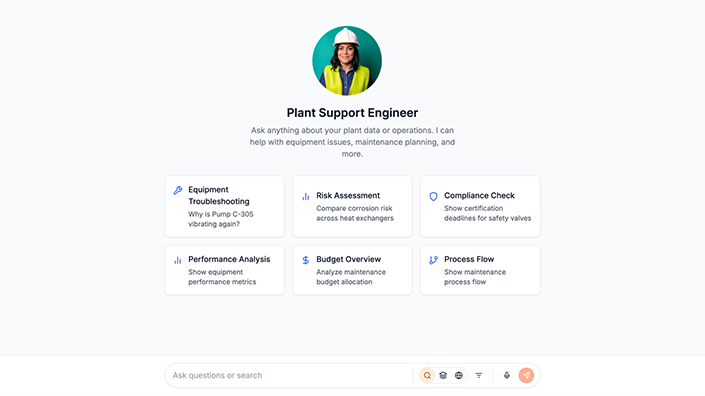
The IntuigenceAI interface
Quick and easy consultations with human engineers in the field is a key selling point, Tanabian says. The company, backed by more than $10m in seed funding, has not publicised how much its software costs.
Along with the price, another question for prospective clients will be whether their in-house data is sufficiently mature. This could be an issue for UK businesses, many of which lag behind on digitalisation.
But AI can actually accelerate this process, Tanabian claims. Where human data engineers once spent months cleaning and inputting operational data, engineering diagrams and other documentation into digital models, the CEO says his software, with integrated multi-models, can now provide a “data foundation” in minutes.
“That said, your factory, your plant or your construction site has to be instrumented with sensors. We rely on data coming in – the temperature for this heat exchanger, pressure for this compressor, flow rate for this pump,” he says. “Thankfully, most Fortune 1,000 companies that are in industrial operations have already instrumented with IoT [Internet of Things] sensors.”
Layering up
While IntuigenceAI’s synthetic engineers grab the attention, they are far from the only AI assistants entering the industry. Email inboxes and tech websites are awash with new releases, with varied levels of sophistication and human-like interaction coded in. Other products include PTC’s Arena AI Assistant and engineering ‘copilots’ from Leo AI and Ansys.
CAM Assist from London manufacturing software firm CloudNC is another example. Used at more than 1,000 machine shops around the world, the tool is an AI ‘layer’ added to CAM (computer-aided manufacturing) platforms such as Autodesk Fusion, Mastercam and Siemens NX. The software is designed to accelerate the CAM programming journey from CAD models to finished parts, providing machinists with strategies, workflows and machine-ready cutting toolpaths.
-18-hi-res-copy.jpg?sfvrsn=f43f5911_0 "CLOUD NC (portraits)-18-HI-RES copy")
Andy Cheadle
CloudNC’s bosses came from a metal 3D-printing background and were “frustrated” by the complexity of programming CNC (computer numerical control) machines, says chief technology officer Andy Cheadle. “The founders wanted to do for precision manufacturing – CNC machining, subtractive manufacturing – what can be done for 3D printing, which was that you upload the model and then it’s much simpler, with a number of simple operations, to actually get a manufactured part.”
The technology is mainly used for medium-batch and medium-complexity parts at UK aerospace, defence and automotive firms. The AI is designed to get programs 60-80% ready, Cheadle says, before a human takes over and adds their expertise.
Setting the standard
Unlike some purely software-based companies, Cheadle says CloudNC is proud to “dog food” its own products, testing them in-house at its facility in Chelmsford, Essex. This approach ensures the AI is solving real problems that customers face, he says.
The tool is designed to tackle two wider challenges. “There’s a scarcity in the workforce. People aren’t coming into the industry as fast as we need,” he says. “If you’ve offshored it, suddenly trying to stand up a skilled workforce is quite challenging.” Accelerating workflows could reduce the need for human engineers. CloudNC says its software has also helped untrained staff get to grips with CAM programming by showing the process needed to generate toolpaths.
AI systems can also standardise techniques. “There are so many different ways CAM programming can be done,” Cheadle says, from the chosen material to the complexity of the model, the available cutting tools and the toolpaths. “Everyone brings their own approach – which is great, except in an environment where margins matter, throughput and deadlines etc. Being able to hand off work to other members of the workforce, team members and colleagues, is difficult if people are bringing different approaches. So the AI system brings a standardisation that allows people to collaborate more effectively.”
From pencils to AutoCAD
Developers are keen to stress the ongoing importance of human judgement. The new 2.0 version of CAM Assist, for example, introduces more opportunities for human input throughout the process, rather than just at the end. Now users can provide feedback throughout the strategy generation process and review everything before the lengthy toolpath generation phase.
“What we tried to do is involve the human more in the understanding of the strategy, rather than just dumping a toolpath on them at the end of the process and saying, ‘There you go’,” Cheadle says. The aim is for a more nuanced relationship between human and AI, allowing engineers to focus on more complex tasks.
At IntuigenceAI, Tanabian claims the company’s platform could make every human engineer “at least an order of magnitude more productive”. “At some point, we used to use a pencil and a drawing table and T rulers to draw diagrams. Now everyone uses AutoCAD. It’s impossible to not think of using AutoCAD for drawings – it’s the same thing. There were engineers who did not transition from pencil to AutoCAD. Don’t be one of those.”
A new skillset
While CEOs at companies introducing AI assistants will inevitably project ever-increasing efficiencies and record-breaking profits, engineers might be forgiven for wondering about job security.
For years, bosses have claimed that increased automation and the hypothetical introduction of AI tools would not lead to smaller workforces. Now those tools are here, many of those same businesses are frustrated by a lack of available talent, raising the possibility that AI agents might be used to plug the skills gap. There is no consensus on such a contentious topic.
“It’s pretty clear that these machines are going to replace an awful lot of people,” says John R Williams, professor of information engineering at MIT. “Workflows will be the first thing
to do, but it’s going to change business models.”
On the other hand, says Ben Hicks, professor of mechanical engineering at the University of Bristol, AI uptake is driving the recruitment of data scientists and other multidisciplinary experts. “Whether the headcount will reduce as a consequence of these tools, I don’t know,” he says.
“Most companies, I would suspect, imagine that the total headcount might well increase, but the nature of the roles will change.”
Pivot point
AI is unlikely to solve all of the issues caused by the skills gap, says IMechE education and skills policy lead Lydia Amarquaye. “Where I think skills need to be developed is actually the understanding of the information being given from these AI tools, to then help make informed decisions. We’re in a bit of a pivot point, so we need to understand what those skills are and what the tools are able to do.”
Those topics are at the forefront of discussions at the Alan Turing Institute, the national institute for data science and AI, based at the British Library in London. Turing’s data-centric engineering specialist Professor Adam Sobey says AI tools could reduce the need for engineers to do repetitive and simple tasks, making roles more attractive in the short term. Beyond that, they could augment the knowledge of young engineers, reducing some of the need for support from senior colleagues.

Adam Sobey
In the long term, however, Sobey says widespread deployment of AI software could “open up a new skills gap”. The institute hopes this could be filled by a new set of data-centric engineering skills for higher education.
“We will need more engineers who have a better understanding of AI/machine learning and data science. We already have a crammed syllabus and it is difficult to see how we add these skills,” Sobey says.
“I see a lot more reliance for engineers on CPD and the need to upskill through life. Technology is only going to move faster now.”
Prompt engineering
That rapid pace of change could make it difficult for students and trainees to know what to focus on as they plan to enter the world of engineering. Thankfully, the experts say, there are several areas to prioritise for future success in an AI-augmented industry.
“Most engineers would benefit from an increased understanding of statistics,” Sobey says. “It’s important that most engineers understand the limitations of AI/machine learning, and that they can see when it might be most beneficial to their workflow, rather than being experts in implementing it.”
‘Prompt engineering’, the ability to coax the best results out of AI tools by fine-tuning requests, is another key area of focus.
“If you prompt in three sentences, you’ll get one answer. If you prompt in 20 pages, you’re going to get a much better answer,” Williams says.
Critical thinking ability is another trait being sought out by firms, Amarquaye says. “AI tools will give you so much information. But how does one use that information to make key decisions?”
A world with a billion engineers
It is still early days in the AI revolution, and commentators are wary of committing to definite predictions of how far it will go. Along with data maturity, challenges for companies will include the price of investment and the technology’s high energy use.
New capabilities will undoubtedly emerge as technologies mature, bringing their own challenges and opportunities. AI agents could be used to interview retiring engineers, for example, capturing that knowledge for the next generations. Other opportunities for wider integration will arise as industrial robots become more capable.
However else the profession evolves, there is clear potential for increasingly advanced AI tools to multiply the capacity of human engineers to create a much larger hybrid workforce. “Imagine a world that has 1 billion engineers,” Tanabian suggests. “It’s going to be a much better world – in terms of building much more energy-efficient machinery, dealing with the climate, dealing with easier and safer cities, roads, buildings.”
It is a tantalising prospect – and one that could soon be within reach.
Want the best engineering stories delivered straight to your inbox? The Professional Engineering newsletter gives you vital updates on the most cutting-edge engineering and exciting new job opportunities. To sign up, click here.
Content published by Professional Engineering does not necessarily represent the views of the Institution of Mechanical Engineers.