Among the many engineers who advanced the art of supercharging, Ernest Eldridge stood out. Although felled at 40 by pneumonia, he designed and built cars and engines that won races and set records in the buccaneer style of the 1920s.
Thirteen years younger than Parry Thomas, who was famed for his low-profile racers and powerful record-breakers, Ernest Arthur Douglas Eldridge paralleled the older man’s career in remarkable respects. Although styling himself as ‘automobile engineer’, Eldridge lacked the credentials and career in the profession that underpinned the work of Thomas. The bespectacled Londoner compensated with an early interest in aviation that found him racing at Brooklands in vast aero-engined cars in the early 1920s. With one such he set a new world land-speed record at 145.89mph (234.79km/h) over the mile on 12 July 1924.
Earlier in 1924, on 7 March Eldridge had lodged a remarkable patent on a means of supercharging. It pictured an in-line six with twin overhead camshafts and valves at a 90-degree included angle. However, between the head and the crankcase were two more camshafts and valve sets on both sides of the engine for a total of six a side, driven by gears from the clutch end of the crankshaft.
Manipulated by the connecting rod was a tubular sliding member topped by a vestigial piston and having a piston below as well above the gudgeon pin. A central fixed collar formed two air-moving chambers at top and bottom. On the engine’s left side the two sets of valves controlled air entry to the chambers, which delivered compressed air through the valve pairs on the right to a chamber running the length of the engine. Inside it was a carburettor that delivered a supercharged mixture through a manifold to the inlet valves.
Eldridge specified control modes for the four supercharging camshafts to achieve the desired pressures in accord with the engine’s operating cycle. While the inlet passages shown in his patent seem ludicrously small, this was a schematic detail in a remarkable flight of imagination for a novel means of supercharging. No evidence survives that such an engine was ever built.
Like Thomas, Eldridge greeted the new 1½-litre Grand Prix rules of 1926 with striking new automobiles of his own creation, built at his Paris workshops. In fact, he was ready in 1925 to compete in the Voiturette category. Two were made, the first of which made use of a modified Amilcar Grand Sport chassis. The second, which featured ultra-low lines, carried its Eldridge-designed frame below its axles at both front and rear – like the Thomas Flat Irons – to achieve its ground-hugging profile.
Instead of starting from scratch like Thomas, Eldridge chose the ubiquitous side-valve Anzani four as the basis of his car’s engine. Taking advantage of its low-friction bottom end, he enhanced this further by fitting roller bearings. Adding a Cozette supercharger fed by an SU carburettor brought its power to 80bhp at 5,500rpm. He fitted the Amilcar chassis with a single-seat fabric body by Gordon England.
In this format, driven by its designer, the Eldridge Special set a new 1½-litre speed record at Brooklands with a two-way run averaging 113.20 mph. At Montlhéry in 1925, Eldridge set class records at up to 121.76mph (195.95km/h) for five miles. He also followed three Talbots home in the Grand Prix d’Ouverture at Montlhéry. Although his second lower-chassis car was ready later in 1925, it was out of luck at Monza and San Sebastian.
For 1926, an enhanced version of the engine was ready. Ernest Eldridge fitted twin-cam cylinder heads with valves at 90 degrees, using his own design. Drive to the cams was by a roller chain at the engine’s clutch end. Driven by the crankshaft nose was an accessory gear case at the front. In an early version the magnetos for the engine’s dual ignition were along its left side, while later engines had them driven by the noses of the camshafts.
Mounted vertically on the right side of the accessory case and driven by skew gearing was a bespoke Roots blower with its shafts in the longitudinal plane. Drawing from a side-draft 44mm Solex carburettor on the right, it pressurised a Y-shaped inlet manifold with a spring-loaded pop-off valve that vented downward. Feeding the Solex was an external forward-facing funnel on the right side of the bonnet. Compact and impressive, the best Eldridge engine was said to give 122 bhp at 5,600 rpm with a 5.2:1 compression ratio. While one engine had the Roots the other kept the original Cozette, delivering through the end of a log manifold.
Perhaps surprisingly, during the years in which the Grand Prix and Indianapolis 500-miles rules were identical, few Europeans came to Indiana to try their hand at collecting greenbacks. One who did was Ernest Eldridge in 1926. In the Amilcar-chassis car, painted the green that was to become unlucky at the Speedway, the builder was fourth-slowest qualifier and retired on lap 45 with steering trouble. Its low-built silver sister, driven by W. Douglas Hawkes, qualified at a respectable 94.977mph (152.851km/h) but retired on lap 91 with a frozen camshaft after many pit-stop tribulations.
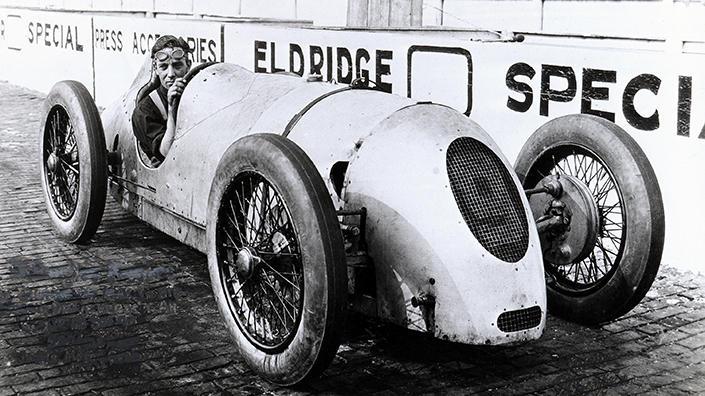
Eldridge brought his 1.5-litre racer to the Indy 500 for Douglas Hawkes to drive in 1926
Impressed by the Indianapolis Millers, Eldridge raced one in America and brought it back to Europe to attempt records at Montlhéry. In the last day of 1926 he successfully set a new world record for one hour at the speed of 126.59mph (203.73km/h). Pressing on for more records on the French oval’s steep banking, a collapsing front axle triggered a tumultuous crash that cost him the sight of one eye. Although the wealthy Eldridge stayed active as driver, designer and organiser, his flair for adventure and innovation was lost to the sport when he died of pneumonia in October of 1937 at the age of only 40.
In a scheme engineered by Ernest Eldridge, in 1928 the centrifugally blown engine from his crashed 2.0-litre straight-eight Miller was transplanted into a Lea-Francis chassis complete with that marque’s distinctive angular radiator. Built without Lea-Francis sanction to the order of Vulcan chief Charles Wardman, who entered the half-dozen Hypers in the 1928 TT, this unique concoction tackled the British Class E hour record set previously at Brooklands by the engine in its Miller chassis. Driven by Harold Purdy it achieved this with a distance covered of 110.63 miles (178.04km) – a five-mile improvement.
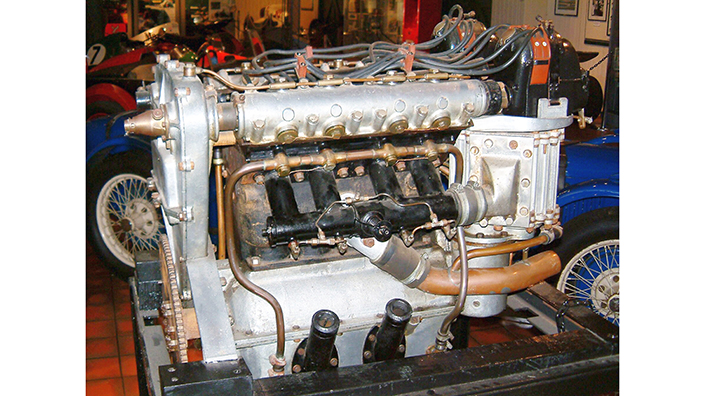
At its ultimate development stage as seen at Brooklands, the Eldridge four had a Cozette blower drawing from a single SU carburettor and dual ignition from magnetos
Want the best engineering stories delivered straight to your inbox? The Professional Engineering newsletter gives you vital updates on the most cutting-edge engineering and exciting new job opportunities. To sign up, click here.
Content published by Professional Engineering does not necessarily represent the views of the Institution of Mechanical Engineers.